Blogs

Not Mokṣa. Something Deeper.

Let me ask you something—
is the goal of spiritual life just mokṣa?

It sounds right. But Jiva Goswami says:

Even mokṣa is not the goal.

Through the Srimad Bhagavatam, he concludes:
The goal is prīti—pure love for Krishna.

Why?
Because mokṣa still centers on me—“I want freedom.”
But love removes that center. It simply gives.

That’s why Chaitanya Mahaprabhu expresses:

“Whether You accept me or reject me… still, You are mine.”

And love is attained Simply by śravaṇam and kīrtanam.
Not by trying to feel love, but by practicing sincerely.

How do you know it’s real?

Two natural symptoms which appear:

  • Ullāsa — steady joy, untouched by situations
  • Mamatā — a feeling: “Kṛṣṇa is mine, and I am His”

One thought to sit with

If you expect nothing in return—not even liberation…

Would you still choose Kṛṣṇa?

The Two Powers That Change Everything in Bhakti

Here are a few thoughts, a couple of sharp lines, and one question to sit with…
but before that, a quick update.

We think people move ahead in bhakti because they’re more pure, more blessed, or more intelligent.

Bhagavad Gita makes it simple:
the mind is difficult—but it can be trained through abhyāsa and vairāgya.

So what’s really missing?

Just two powers:

The power of “NO” (Vairāgya)
Thoughts will come—that’s just the mind working (cognition).
But you don’t have to follow them.
Growth begins when you stop saying yes to everything inside.

The power to think about your thinking (Abhyāsa)
Not just repeating—but observing.
“Why did I drift?”
“What can I correct?”
This is metacognition—and this is real practice.

In one line:

Don’t just think—see your thinking.
Don’t just feel—choose your response.

One question:

Where today will you say one clear “NO”…
and where will you pause and correct?

Start there.

Mahātikramā – The Hidden Reason Things Fall Apart

Sometimes life is going well—health, clarity, reputation, blessings…

And suddenly, everything starts collapsing.

Why?

The principle is simple: “Mahātikramā” — crossing the line set by great souls.

Here are the 5 powerful meanings—short and practical:

1. Offending Great Souls

Disrespecting saintly people or genuine devotees destroys:

  • clarity
  • blessings
  • reputation
  • inner stability

 Result: everything declines, even if it looks fine outside.

2. Shortcut Mentality

Trying to skip the process:

“I’ll jump directly to the top.”

Real growth doesn’t work like that.

 If you skip steps, you lose the result.

3. No Step-by-Step Growth

Forcing yourself suddenly to over-studying ,over-chanting ,extreme discipline overnight

Leads to burnout frustration breakdown

 Growth must be gradual, not forced.

4. Independent Mentality

Thinking:“I’ll do it my way. I don’t need guidance.”

This stops real learning.

 First learn to follow, then lead.

5. Ignoring Guru–Śāstra–Sādhu

Going outside authentic guidance leads to:

  • confusion
  • wrong decisions
  • shallow progress

 Stay aligned with wisdom, not just your mind.

Final Law of Life

Move step by step, under guidance.

“Don’t try to become great. Become humble—and greatness follows.”

Core Teachings from Lord Narasimha’s Līlā

The appearance of Narasimha is not merely a historical event — it reveals essential truths about
the nature of bhakti.

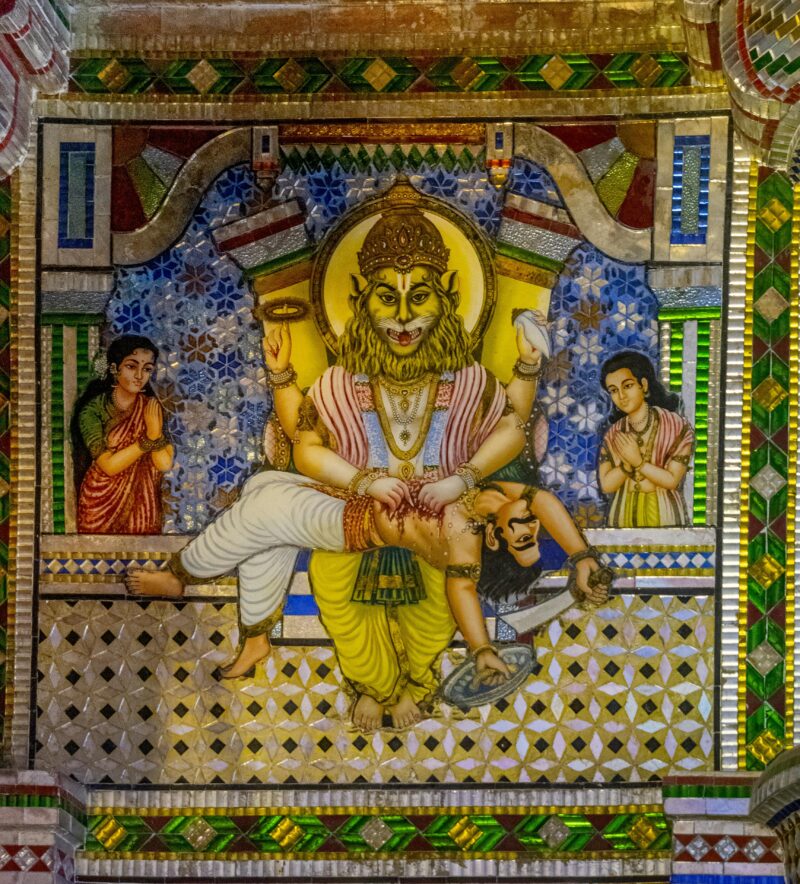
1. Avatāras Reveal Specific Qualities Each manifestation of the Lord emphasizes particular qualities. Kṛṣṇa manifests prema-līlā. Rāma establishes maryādā. Narasimha, above all, reveals bhakta-vātsalya — the Lord’s profound, protective love for His devotee.

2. The Lord’s Anger Is Rooted in Love His wrath is not independent — it arises entirely from His love for His devotees. What appears as fury is, in truth, protection. A devotee looks beyond the anger to the intention behind it.

3. The Lord Is Omnipresent By emerging from a pillar — neither inside nor outside, neither animate nor inanimate — He establishes that He is present everywhere, unconstrained by place or form.

4. Śraddhā Draws the Lord Prahlāda Mahārāja remained steady through repeated danger and persecution. It is this unshaken śraddhā — not argument, not power — that drew the Lord directly to him.

5. The Power of the Holy Name Prahlāda did not rely on his own effort for protection. Remaining absorbed in remembrance of the Lord, he simply trusted — and the Lord intervened. The Name itself is the shelter.

6. From Protection to Service We may begin by approaching the Lord for protection in times of difficulty. But the deeper prayer is this: may He appear within the heart and engage us in His service.

The question is: Are we protecting ourselves, or depending on Him?

    From Brahma-jijñāsā to Bhagavān

    Vyāsadeva begins the Śrīmad Bhāgavatam with a purpose—not poetry, but precision.

    The Vedānta-sūtra opens with:
    “athāto brahma-jijñāsā”Now, inquire into Brahman.

    But inquiry demands clarity: Who is Brahman?

    The Bhāgavatam answers in its very first line:
    “janmādy asya yataḥ”The source of creation, maintenance, and dissolution.

    This is not an abstract principle. This is Bhagavān.

    In one stroke, Vyāsadeva transforms Vedānta’s question into realization:

    • Brahman is not impersonal
    • Brahman is Bhagavān
    • The source of everything is a conscious, supreme person

    Thus, the Śrīmad Bhāgavatam is not separate from Vedānta—it is its natural, living commentary.

    Vedānta begins with inquiry.
    Bhāgavatam completes it with revelation.

    Akshaya Tritiya — What Will You Choose to Keep Forever?

    Let me ask you something.

    What if there was a day…where whatever you do never diminishes?

    That’s Akshaya TritiyaAkshaya means “that which never decreases.”
    No muhurta needed. The day itself is complete.

    The Day Speaks Through Stories

    • Yudhishthira receives the Akshaya Patra—endless sustenance
    • Krishna satisfies sages with a single grain for Draupadi
    • Sudama returns from nothing to abundance
    • Ganga descends to purify the world
    • Parashurama appears—upholding dharma
    • Vyasadeva begins the Mahabharata
    • Kubera attains wealth and position
    • Rishabhadeva breaks a year-long fast
    • Preparation begins for Ratha Yatra
    • The sacred grain barley manifests
    • Chandana Yatra begins—cooling the Lord with sandalwood
    • Vijayadwaja Tirtha is remembered for his legacy

    Different events. One idea:

    What is done today… multiplies and remains.

    So what should you do?

    Keep it simple:

    • Chant
    • Serve
    • Give

    Even a small act—done sincerely—doesn’t fade.

    One question to sit with

    If today’s actions never fade…
    what is truly worth doing?

    Seven Truths Only the Bhagavad Gītā Dares to state.

    You know how most spiritual texts feel distant… abstract… almost like they’re speaking above you?

    But the Bhagavad Gītā doesn’t do that.

    It steps right into your life—your confusion, your fear, your everyday chaos—and then it says something bold… things most texts don’t dare to say out loud.

    Let me walk you through it.

    First—God doesn’t stay distant. He comes down.

    Kṛṣṇa says something radical:
    “Whenever things fall apart… I come.”

    Not metaphorically. Not symbolically.
    He descends—again and again.

    👉Not a silent God.
    👉Not an absent God.
    👉A God who intervenes.

    That’s the idea of avatār.

    Second—God isn’t just some formless energy. He’s… personal.

    He thinks.
    He feels.
    He loves.

    Let that sink in.

    We’re not talking about an abstract force floating in the universe.
    We’re talking about a being—with presence, with emotion.

    👉Not emptiness.
    👉Not void.
    👉Relationship.

    Third—your daily life? That’s the path.

    You don’t need to run away to a cave.

    Eating. Working. Walking. Living.

    The Gītā says—do all of it with awareness, with devotion… and it becomes yoga.

    👉Not escape.
    👉Transformation.

    Your life doesn’t need to change.
    Your way of living it does.

    Fourth—death is not random. It’s precise.

    Whatever is in your mind… in your final moment
    That’s where you go next.

    Read that again.

    👉Your last thought = your next reality.

    So life?
    It’s not just living.

    It’s training your mind for that one decisive moment.

    Fifth—love beats everything.

    Knowledge is great. Discipline is great.

    But the Gītā quietly leans in and says:

    👉“The one who loves Me… is the highest.”

    Not the smartest.
    Not the most ascetic.

    The one who feels.

    Sixth—control isn’t the key. Surrender is.

    At the very end, Kṛṣṇa drops everything else and says:

    👉“Leave it all… and come to Me.”

    No conditions. No complexity.

    Just surrender.

    Because here’s the truth—
    You can’t hold onto everything and hold onto God.

    Seventh—and this one challenges the ego directly…

    You don’t become God.

    You don’t dissolve and take His place.

    Kṛṣṇa remains… beyond.

    👉You can reach Him.
    👉You can love Him.
    👉You can unite in devotion.

    But He is still… Him.

    And that’s what makes the Bhagavad Gītā different.

    It doesn’t just talk about truth.

    It speaks to you.

    A God who comes.
    A God who feels.
    A God who waits—
    for you to turn… even once… in His direction.

    And maybe that’s the real question it leaves you with:

    👉When everything falls away… what will your mind hold onto?

    The Three Pillars of the Bhagavad Gita

    The Bhagavad Gita Asks Three Things of You. Only Three.

    Nisvārtha ( Selfless)— Chapters 1–6

    Do nothing for yourself. Whatever you do — dharma, bhakti, yoga — if svārtha is behind it, the result will not come. Where there is svārtha, there is mṛtyu. Depression. Frustration. The slow death of the inner life.

    Not my happiness. Not my distress. Bhagavān’s happiness. Bhagavān’s distress. The moment the center shifts — everything changes.

    Śraddhā (Faith)— Chapters 7–12

    Trust completely — but correctly. Not that God will protect your health and wealth. He will protect your bhakti. Accept His words — that is the only condition. Śraddhā grows into āsakti. Āsakti deepens into prema. From intellectual faith to lived love.

    Vairāgya (Renunciation)— Chapters 13–18

    Let the world stop making impressions. Not renunciation. Not effort. Only mercy. The test — sit and chant. Watch where the mind goes. Whatever pulls it — that impression still lives. The mind does not lie.

    Reflection

    Nisvārtha removes you from the center. Śraddhā places God there instead. Vairāgya ensures nothing pulls you back.

    The Gita is not asking you to become extraordinary. It is asking you to stop being in the way.

    Jai Hanuman!

    Among the eight immortals, Hanuman stands alone.

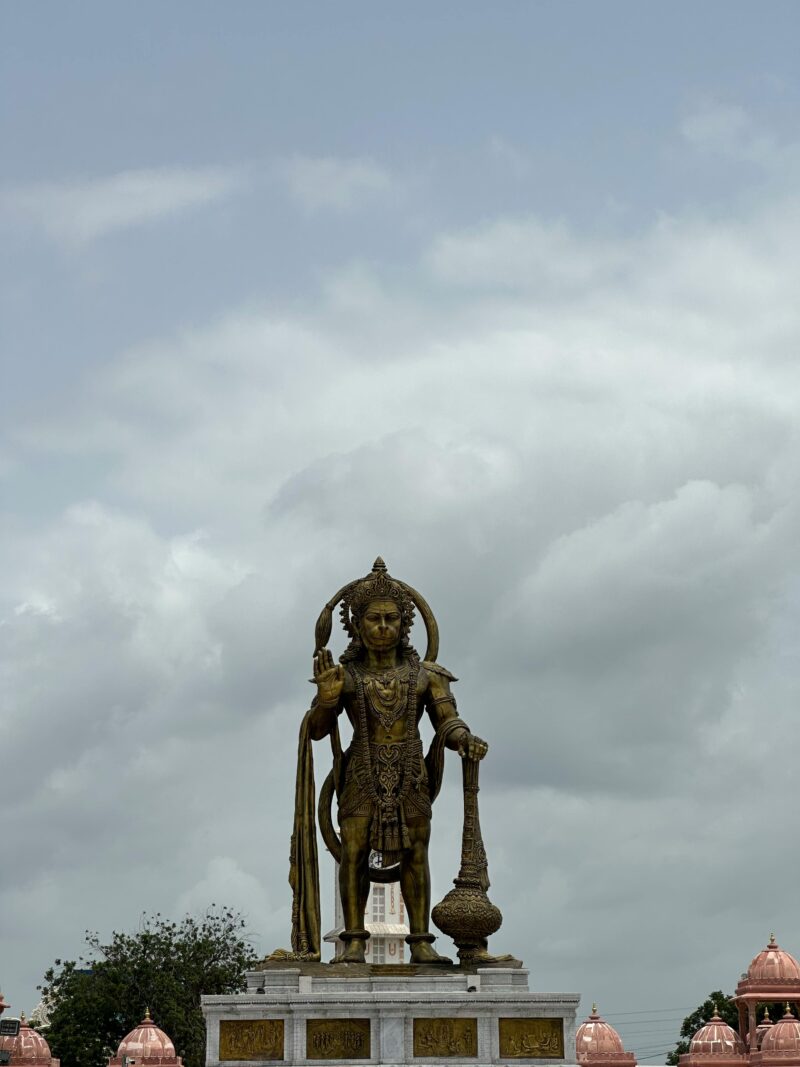
    ​Born of the wind, his entire existence was a kinetic offering to Rama. He crossed oceans, burned empires, and moved mountains. He possessed the raw strength to annihilate Ravana single-handedly.

    ​Yet, he withheld the final blow.

    ​He deliberately kept his ultimate power hidden…

    You know why?  

    Because he erased his own ego so his Master could claim the glory.

    ​That is the absolute apex of devotion. Humility isn’t a lack of strength. Humility is possessing world-breaking power, and choosing not to use it, simply to elevate your Lord.

    Compassion of Sri Chaitanya Mahaprabhu.

    A famous verse composed by Rupa Goswami glorifies Him:

    Namo mahā-vadānyāya kṛṣṇa-prema-pradāyate
    Kṛṣṇāya kṛṣṇa-caitanya-nāmne gaura-tviṣe namaḥ

    Chaitanya Mahaprabhu is described as the most munificent incarnation because He freely distributed Krishna-prema (love of God). He is Krishna Himself, appearing in the form of a devotee, to teach the chanting of the holy name.

    The Central Teaching: The Supremacy of the Holy Name

    Mahaprabhu emphasized that among all processes of devotional service—hearing (śravaṇam), chanting (kīrtanam), remembering (smaraṇam), worship (arcanam), offering prayers (vandanam), serving (dāsyam), friendship (sakhyam), and full surrender (ātma-nivedanam)—the most important is nāma-saṅkīrtana, the chanting of the holy name.

    Without the holy name, nothing has real value. All other processes—karma-yoga, jñāna-yoga, tapasya, charity, austerity—are insignificant compared to the chanting of the name of God. The holy name stands above everything.

    Although many saints such as Tukaram, Tulsidas, and Ramanujacharya emphasized the importance of God’s name, Chaitanya Mahaprabhu did something unique. Through His followers, He established a vast body of scholarly literature in Sanskrit exclusively focused on bhakti and the science of the holy name.

    Why Sanskrit? A Strategic Vision

    Mahaprabhu instructed His followers, especially the Six Goswamis of Vrindavan, to write in Sanskrit. Although they were fluent in Bengali, Hindi, and even Persian, they deliberately chose Sanskrit—the scholarly language of authority.

    Because Mahaprabhu was thinking of the future. If the teachings were only written in local languages, scholars might dismiss the movement as sentimental. By establishing the philosophy with scriptural evidence in Sanskrit, He ensured that intellectuals, philosophers, and highly learned people would take it seriously.

    His target was not merely the masses. For the masses, there was kirtan—chanting, dancing, and joyful participation. But for the intellectual class, there had to be deep philosophy.

    As Srila Prabhupada often summarized:
    “Kirtan for the masses, philosophy for the classes.”

    Mahaprabhu debated great scholars and Mayavadis. He transformed Sarvabhauma Bhattacharya, the greatest scholar in Jagannath Puri, and influenced King Prataparudra. When leaders and intellectuals change, society follows.

    A Multi-Level Mission

    Mahaprabhu’s strategy was systematic:

    • He personally performed public kirtan to attract ordinary people.
    • He sent Nityananda Prabhu to preach to wealthy merchants and even dacoits.
    • He instructed Rupa and Sanatana Goswami to write philosophical works to defeat impersonalism and establish pure bhakti.

    He spread a net of divine love across all levels of society—common people, scholars, leaders, wealthy individuals, and even animals. His compassion was not random; it was strategic.

    From Mission to Movement

    Following this same mood, Bhaktisiddhanta Sarasvati Thakur established the Gaudiya Mission. He deliberately used the word “mission,” indicating an organized effort to transform society, not merely a temple institution.

    Later, Srila Prabhupada expanded it globally as the International Society for Krishna Consciousness—a movement. When a mission spreads worldwide and becomes a spiritual revolution, it becomes a movement.

    This was not accidental. It was deliberate, intelligent planning rooted in compassion.

    Compassion Requires Intelligence

    Real mercy is not sentimental. It requires intelligence and strategy.

    It is not enough to simply distribute prasadam or open temples without thought. One must consider:

    • How will people be attracted?
    • How will they stay?
    • How will they be elevated spiritually?

    Large marble temples may attract certain people. A simple rural ashram may attract others. A Vedic college may attract intellectuals who would never step into a temple. Different approaches are required for different audiences.

    However, strategy must remain pure. There must be no manipulation, no exploitation, no lower modes of attraction. Introducing rajasic or tamasic elements to draw crowds—such as sensationalism or distortion of principles—ultimately disconnects people from Krishna rather than connecting them.

    Srila Prabhupada clearly said:
    “I will give you the plan; you fill in the details.”

    The details may vary according to time, place, and circumstance, but the principles must never be compromised.

    Preaching as Spiritual Responsibility

    Prabhupada even described preaching as our “business.” Just as a businessman thoughtfully presents a product and explains its benefits, devotees must thoughtfully present Krishna consciousness.

    Our “product” is Krishna-prema.
    Our “brochure” is Bhagavad-gita and the books of the acharyas.
    Our goal is transformation—not profit, not prestige, but spiritual upliftment.

    Mahaprabhu promised that one who sincerely tries to spread the holy name will not be overcome by maya and will ultimately return to Him.

    But there is one condition: no duplicity, no selfish motives, no hidden agendas. Strategy must be guided by sincerity and fidelity to the parampara.

    Namo Mahā-Vadānyāya: Not Magic, but Mission

    When we say “Namo Mahā-Vadānyāya”—we are not speaking of cheap miracles. Mahaprabhu’s mercy is vast, but it works through sincere effort, thoughtful engagement, and dedicated service.

    We must work on ourselves, think about others and must apply intelligence in spreading bhakti.

    Then His mercy flows.

    Simply shouting “Kripa karo!” (Please give mercy!) without responsibility will not bring transformation. Compassion, like Mahaprabhu demonstrated, requires planning, intelligence, courage, and purity.

    That is the real meaning of His munificence—and that is the spirit of this movement.

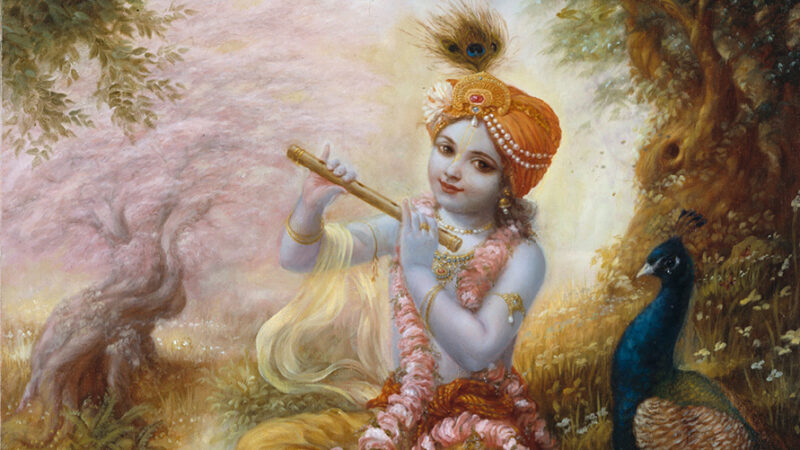
    The Transcendental Power of Krishna’s Flute: Madhurya and Aishwarya United

    In the devotional tradition, Krishna’s flute (venu) is usually understood as an instrument of attraction. When Krishna plays the flute, the gopis are drawn to Him, the cows gather around Him, and even the demigods become enchanted. This understanding is correct—but incomplete.

    The flute does not merely attract.It transforms, overturns, humbles, awakens, and liberates. Rupa Goswami, in a deeply poetic and philosophically rich verse, reveals that the flute embodies not only madhurya (sweetness) but also aishwarya (divine power). In Vrindavan, sweetness appears in the foreground, while immense power operates silently in the background. To say that Vrindavan has only madhurya and no aishwarya is a misunderstanding; both exist together,perfectly harmonized.

    The Flute That Reverses the Laws of Nature

    The verse begins by describing the astonishing effect of the flute on the clouds.

    In Sanskrit, ambu means water, and ambu-bhṛta refers to clouds—the holders of water. Rundhan means “to stop.” When Krishna plays His flute in Vrindavan, moving clouds come to a standstill. They freeze in place, stunned by the sound.

    This reveals the first power of the flute: it reverses dharma—the natural function of things.

    • Flowing rivers stop.
    • Immovable mountains begin to move.
    • Cold becomes warm.
    • Heat becomes cooling.

    What is mobile becomes immobile; what is immobile begins to move. This inversion of natural law exists nowhere else in creation. The flute does what no material force can do—it changes the very nature (svabhāva) of existence.

    This power is the greatest form of aishwarya.

    The Flute as the Symbol of the Guru

    Because the flute has the power to transform nature, the scriptures declare that the flute is the symbol of the Guru.

    Just as the flute connects Krishna with the gopis,the Guru connects the soul with Krishna.

    Without the flute, the gopis would never know that Krishna is calling them.
    Without the Guru, the soul never understands what God wants, why He calls, or how to respond.

    Thus, in Vrindavan, the flute is not merely a musical instrument—it is divine guidance made audible.

    A Sound That Is Not Material

    Ordinary sound cannot stop clouds, halt rivers, or move mountains. Therefore, the sound of Krishna’s flute is not material. It is aprakṛta—fully transcendental.

    This sound is:

    • Śabda Brahman
    • Om
    • Gayatri
    • The voice of the Vedas themselves

    At the beginning of creation, Lord Brahma received initiation not through spoken words, but through the sound of the flute. The Gayatri mantra emerged from that sound, and according to that realization, Brahma created the universe.

    Thus, in Vrindavan, the Vedas are not recited—they are played.

    The Flute That Destroys Ego

    When the flute sound ascends to the heavenly realms, it reaches Tumburu, the greatest Gandharva musician. Even Narada Muni cannot match him.Yet Tumburu becomes completely bewildered.

    He cannot identify the raga, the progression, or the structure of the melody. For the first time in his existence, his mastery fails him.

    This reveals the second power of the flute: it annihilates ego, even in the most accomplished beings.

    What learning cannot dissolve, the flute does effortlessly.

    Beyond Knowledge: Breaking Impersonal Absorption

    The flute sound then rises to Tapoloka, where the Four Kumaras—Sanaka, Sanandana, Sanatana, and Sanat-kumara—are absorbed in meditation on the formless Absolute.

    Their meditation is so deep that even cosmic destruction does not disturb them.

    Yet the flute breaks their trance.This reveals a profound truth:Bhakti transcends jñāna.

    The flute pulls the soul out of impersonal silence and calls it toward loving service. The Guru does the same—when a devotee becomes attached to mere peace or stillness, the Guru says, “Enough. Now serve.” In the kingdom of bhakti, peace is not the goal—loving engagement is.

    The Flute That Astonishes Brahma

    When the sound reaches Satyaloka, even Lord Brahma is stunned.

    Brahma is The source of the Vedas,The architect of the universe and is Formed entirely of Vedic sound

    Yet he realizes that all the Vedas exist within a single note of the flute—the fifth note, Pa, considered the most beautiful and complete tone in music.

    In that single vibration exists:All knowledge,All mathematics,All cosmic engineering

    This is not theoretical knowledge—it is experienced realization.
    Thus, the flute gives what the Guru gives: realized wisdom, not merely information.

    The Flute That Breaks Dharma

    The sound then descends to Sutala, where Bali Maharaja resides—the embodiment of dharma, patience, and surrender.Yet even Bali becomes restless.

    This reveals another power of the flute:
    it breaks even righteous restraint when it obstructs devotion.

    Just as the gopis abandoned social and moral boundaries upon hearing the flute, the Guru breaks attachments—not only to sinful habits, but even to respectable dharma—if they stand in the way of pure bhakti.

    The Flute That Moves the Unmoving

    The sound reaches Ananta Shesha, who supports the entire universe. He never moves, for even slight movement would shake creation.

    Yet the flute makes him spin in ecstasy.

    What is eternally still begins to move.

    The lesson is clear:Spiritual life must never stagnate.

    The Guru never allows stillness that leads to decay. Constant engagement is life; stopping is death.

    Piercing the Universe and Reaching Vaikuntha

    Finally, the flute sound pierces the coverings of the universe and enters Vaikuntha. No material sound can do this.

    This establishes the final truth:

    The Guru alone is the bridge between the material world and the spiritual world. There is no other link.

    The Seven Powers of the Flute (and the Guru)

    1. Transforms nature
    2. Destroys ego
    3. Breaks impersonal absorption
    4. Grants realized knowledge
    5. Breaks rigid moral boundaries
    6. Prevents stagnation
    7. Leads the soul beyond the universe

    Why the Gopis Are Jealous of the Flute

    The flute always touches Krishna’s lips and constantly drinks His adharāmṛta. The gopis ask:

    “What austerities has the flute performed to receive what belongs to us?”

    The answer is simple:

    • The flute is empty
    • The flute has no ego
    • The flute exists only for service

    Therefore, Krishna never puts it down.

    Conclusion

    Meditation on Krishna’s flute grants the same result as Vedic chanting, philosophical study, and prolonged austerity—because the flute contains them all.

    Gaudiya Vaishnavism teaches a complete path:

    • Philosophy and leela together
    • Knowledge and rasa together
    • Depth without dryness

    When one remembers Krishna’s pastimes deeply, all philosophy naturally reveals itself.

    This is the secret of the flute.

    Shiva: The “White” Vaishnava & The Department of Zero

    In the Srimad Bhagavatam, Shiva is defined as Vaishnavanam Yatha Shambhu—the crown jewel of all devotees. While popular culture depicts him as blue, the Puranas describe him as Shuddha-Sphatika: pure, snow-white, and radiant.

    Shiva is not a person in the traditional sense, but a Post. Depending on the era (Kalpa), this post is occupied by a highly qualified soul (Jiva), or, if no one is ready, Vishnu himself expands to fill the role. He is the HOD of Tamoguna, working under the “Dean” (Vishnu) and the “Director” (Krishna).

    The Divine “Department of Zero”

    Shiva manages Vinash (Destruction), Andhera (Darkness), and Chanchalata (Restlessness). * Destruction is Divine: Just as old leaves must fall for new ones to grow, or sleep must “destroy” our wakefulness to heal the body, Shiva’s job is to clear the clutter.

    • Making everything Shunya: Yogis worship him because his work is to make the mind empty (Shunya), stripping away material noise to reveal the soul.

    The  Core Teachings of Shiva’s Lila

    1. God Recycles Your “Flaws”

    You don’t need to be “perfect” to reach the Divine. God is the ultimate alchemist; he uses your natural qualities—good or bad—in his service:

    • Anger: Hanuman’s Krodh burned Lanka for Rama.
    • Greed: Kuber’s Lobh made him the Universe’s Finance Minister.
    • Lust: Daksha’s procreative drive was used to populate the earth.

    The Rule: Every emotion can be a bridge to God, except for Ahankar (Ego) and Dwesh (Malice). These two are the only “unusable” toxins.

    2. The Danger of “Service Ego”

    Daksha’s downfall wasn’t lust; it was Seva ka Ahankar (The Pride of Service). He thought, “I am doing such great work for God.” This “spiritual ego” is the most dangerous trap. It’s why high-level monks in the Madhva tradition walk barefoot and serve others first—it is a tactical defense against the pride that blinded Daksha to Shiva’s greatness.

    3. Proximity = Progress

    Sati lived with Shiva, yet her ego caused her to doubt his word. This is a chilling reminder: physical closeness to the Divine or a Guru means nothing if you aren’t following their Vani (instructions). You can live in the temple and still be miles away in consciousness. Devotion is measured by obedience, not geography.

    4. Ego is Biological Death

    Daksha insulted Shiva and was given a goat’s head—a permanent reminder of his “Mae, mae, mae” (Me, me, me). Metaphysically, adults decline and die because Ahankar activates and creates friction in our cells. Children grow because they are ego-less. To kill the ego is to find eternal life.

    5. Shivratri: The Internal Alchemy

    For the yogi, Shivratri is the union of Shakti (at the base of the spine) with Shiva (at the crown). It is the moment consciousness and energy become one. For the Vaishnava, it is the day we honor the Guru who gives us access to Vishnu.

    The Vaishnava Practice on Shivratri

    We do not fast to “please” Shiva as a separate God; we celebrate him as our greatest Vaishnav.

    • The Mantra: Om Namah Shivaya means “I bow to Shiva, who is the servant of Om (Vishnu).”
    • The Worship: We sing the Rudra Geet—the hymns Shiva himself composed in praise of Lord Vishnu.
    • The Bow: When we offer Pranams to Shiva, we are actually bowing to Lord Sankarshan or Narsingh who resides eternally in Shiva’s heart.

    The Final Takeaway

    Mastering lust and anger is “level one.” The real challenge is destroying the ego of being a devotee. If you remain humble (Deenata), God will even use your flaws in His service. But if you carry the pride of service, you are walking on thin ice.

    Real Tapasya:The Discipline That Makes Us Human

    In today’s world, the word tapasya often sounds intimidating—like extreme renunciation or painful austerity meant only for sages in forests. But according to the Bhagavad-gītā and Bhāgavata Purāṇa, tapasya is not suffering for its own sake. It is conscious self-discipline that transforms ordinary life into a spiritual journey.

    In fact, human life begins with tapasya. Without it, life remains stuck at the level of instinct—eating, sleeping, enjoying, and fearing—no different from animals, except for better clothing and vocabulary. Śrīla Prabhupāda once described modern society as “animals in pants and shirts,” pointing to a life that lacks higher purpose, inner satisfaction, and spiritual direction.

    What Does Tapasya Really Mean?

    Tapasya means doing what is uncomfortable but beneficial in the long run (śreya) rather than what is pleasurable now but harmful later (preya). It is the training that strengthens the body, steadies the mind, purifies speech, and awakens the soul.

    Three Dimensions of Tapasya

    1. Bodily Tapasya: Learning Tolerance and Humility

    Bodily tapasya includes tolerance of heat and cold, comfort and discomfort—conditions Bhagavān Himself created to teach resilience. Animals escape discomfort; humans learn to endure and grow through it.

    But bodily tapasya goes deeper. The Bhagavad-gītā teaches that respecting elders, honoring the guru, and following discipline are also forms of tapasya. In a culture that glorifies ego and independence, humility itself becomes austerity.

    2. Mental Tapasya: Sense Control and Satisfaction

    The tapasya of the mind is controlling the senses. When senses are not constantly fed with material pleasure, the mind gains strength and clarity.

    Even more challenging is the tapasya of satisfaction—remaining content in all situations. Problems exist in everyone’s life, devotees and non-devotees alike. The difference lies in response:
    non-devotees are disturbed by difficulties, while devotees are refined by them.

    Satisfaction does not mean inactivity. It means inner stability—trusting Bhagavān even when circumstances are unfavorable.

    3. Tapasya of Speech: Truth Spoken Sweetly

    Speaking the truth is tapasya. Speaking it pleasantly is greater tapasya.

    Lies and harsh words often bring quick results, which is why they are tempting. But they disturb the conscience. Truth spoken with kindness purifies the speaker. A liar can never be peaceful, while one who walks the path of truth experiences quiet inner strength—even in adversity.

    The Highest Tapasya: Remembering Bhagavān

    The highest tapasya is the tapasya of the ātmā.

    “Always remember Viṣṇu and never forget Him.”
    — Padma Purāṇa

    To remember Bhagavān while eating, walking, working, or resting is real spiritual discipline—because the conditioned mind prefers to glorify the world and itself. If we do not glorify ourselves, we want others to do it for us.

    Bhagavān asks us to reverse this habit: glorify Him instead. This is possible at all times and in all places. Even in confinement or hardship, no one can stop us from remembering and chanting His names.

    Tapasya at the Dawn of Creation

    Tapasya is not a later religious concept—it is as old as creation itself.

    When Brahmā first appeared from the lotus growing from Viṣṇu’s navel, he saw only darkness and felt fear. Then he heard one instruction echoing through the universe:

    “Tapa.”

    Following this command, Brahmā performed deep tapasya. Pleased, Kṛṣṇa revealed divine knowledge through His flute in four essential verses—the catuḥ-śloki Bhāgavatam. From this knowledge, creation unfolded. Thus, tapasya is the foundation of all spiritual and material order.

    Why Bhagavān Loves Tapasya

    Bhagavān declares:

    “Tapasya is My heart.” (SB 2.9.23)

    He is pleased not by indulgence, but by discipline offered in devotion. Yet He gains nothing from our tapasya—we do. A disciplined life sharpens awareness, purifies intention, and brings lasting satisfaction.

    Tapasya may feel bitter at first, but it becomes nectar in the end. Sense enjoyment feels sweet initially, but eventually turns poisonous. This is why the scriptures declare tapasya to be the real wealth of human life.

    The Choice Before Us

    Life is not meant for manipulation, competition, or mere survival. It is meant for self-correction, character building, and awakening love for Bhagavān.

    We always have a choice:

    • Follow blind society, or
    • Follow sādhus and śāstra

    Those who follow Bhagavān’s instructions perfect their lives. Those who understand but do not apply remain dissatisfied.

    The Quiet Sign of Success

    When tapasya is practiced sincerely—through discipline of body, mind, speech, and soul—a subtle confirmation appears within the heart:

    Satisfaction.

    That satisfaction is not excitement or pride. It is the soul’s calm assurance that one is walking the right path—toward Bhagavān.

    The Mediator of Mercy:Why the Sampradaya Begins with “Shri”

    At the heart of the Sri Vaishnava tradition lies a name that is more than a title—it is a doorway to divine grace. The very identifier “Sri” Vaishnava is not merely decorative; it declares the foundational principle of the path. This tradition consciously begins with “Shri,” the divine feminine personified as Goddess Lakshmi. But why? What is the unique, indispensable role of Shri that earns her this prime position in a school of devotion dedicated to Lord Vishnu-Narayana?

    The answer unfolds in the profound etymology of her name, revealing a fourfold function that makes her the essential mediator between the human soul and the Supreme.

    The Fourfold Function of Shri: Etymological Keys to Grace

    Sanskrit, a language where sound and meaning are deeply intertwined, unlocks the mystery through four verbal roots that converge in the sacred syllable “Shri.”

    1. श्रिणोति (Shriṇoti) – “She Hears”

    Lakshmi is the divine listener. In the cosmic order, Narayana is often envisioned as the stern king, the upholder of justice (Dandadhara). A subject may tremble to approach a sovereign directly with a plea. But a queen, especially a mother, has a different disposition. Lakshmi, with a mother’s compassionate ear, is ever inclined to listen. She hears the faintest whisper of the devotee’s heart, the silent cry of the soul feeling distant from God. She is the assurance that our prayers are not lost in the void but are received with empathy.

    2. श्रावयति (Shrāvayati) – “She Conveys and Recommends”

    Hearing is only the first step. Lakshmi then becomes the advocate. She takes the raw, imperfect prayers of the devotee, and with her perfect devotion, presents them to Narayana. She intercedes, translating human longing into a language of divine love that Narayana cannot refuse. In this, she is the ultimate mediator, the vital link (sambandha) bridging the immense gulf between the finite Jiva and the infinite Lord. Without this loving intercession, the devotee’s voice might falter before reaching the throne.

    3. श्रिनाति (Shrināti) – “She Serves”

    Lakshmi’s qualification as mediator is rooted in her own perfect nature. She is Parama Bhagavata, the greatest of all devotees, the supreme servant of Narayana. Her every breath is an act of service. This unparalleled dedication is why Narayana eternally keeps her at His heart—literally and figuratively. She is not an external intermediary but an integral part of the divine whole, representing the principle of loving, selfless service (seva) that is the core of devotion itself.

    4. श्रियते (Shriyate) – “She Gives Refuge”

    This function encompasses a beautiful duality. First, Lakshmi is Sharanagata Vatsala—she lovingly gives refuge to all souls who surrender to her. But in a stunning theological insight, she is also said to give refuge to Narayana Himself. How? As the impartial ruler, Narayana’s direct, unmotivated mercy might seem to bypass the laws of karma. To maintain cosmic order while still dispensing grace, He acts through Lakshmi. By channeling His benevolence through her, it becomes an act of motherly compassion rather than royal partiality. Thus, she is the shelter through which divine mercy flows into the world.

    The Gaudiya Parallel: The Universal Principle of the Divine Feminine

    This theology of mediation finds a direct parallel in the Gaudiya Vaishnava tradition, centered on Radha and Krishna. Here, Radharani is also addressed as “Shri”—in Jayadeva Goswami’s Gita Govinda (“Jaya Shri Lalita”) and in the heartfelt chants of devotees. Her role is identical: no one can approach the captivating but often aloof Krishna without the recommendation of Radha, whose love for Him is perfect and who feels the pain of separation experienced by the other devotees. The popular chant “Radhe” preceding “Krishna” is not just poetic; it is a theological statement of the same principle—access to the masculine divine (Krishna/Narayana) is lovingly mediated by the feminine divine (Radha/Lakshmi).

    Conclusion: The Path of Loving Intercession

    Therefore, to be a “Sri” Vaishnava is to recognize a fundamental truth of devotion: the journey to God is not a solitary, vertical climb. It is a path made possible by a compassionate mediator who hears our call, purifies our intention, pleads our case, and finally, takes us by the hand to the feet of the Lord. The tradition starts with “Shri” because grace begins with her. She embodies the truth that divine love reaches us not only as justice from a father but as merciful intercession from a mother, making the ultimate goal of life not just attainable but inviting.

    The Saintly Vision:Devotion, Mindfulness, and Universal Welfare

    A single spiritual verse captures devotion, dharma, compassion, and a complete guide for social and personal transformation. If people lived according to this verse, society would naturally become elevated and individuals would grow into noble human beings as well as sincere devotees. Srila Prabhupada emphasized that the goal of a spiritual society is to cultivate brahminical qualities—truthfulness, purity, humility, compassion, and spiritual wisdom. These qualities do not arise simply by proclaiming oneself a brāhmaṇa; they develop through genuine connection with God. Without God, even so-called goodness remains incomplete and self-centered.

    svasty astu viśvasya khalaḥ prasīdatāṁ
    dhyāyantu bhūtāni śivaṁ mitho dhiyā
    manaś ca bhadraṁ bhajatād adhokṣaje
    āveśyatāṁ no matir apy ahaitukī

    Ref SB 5.18.9

    Universal Well-Being

    The verse begins with a profound blessing: “Svastu viśvasya”—may the entire world be well. This aligns with the ancient prayer wishing happiness, health, auspiciousness, and freedom from suffering for all beings. True well-being includes physical health, emotional balance, and spiritual purity. A saint naturally prays for the welfare of the whole world, not only for himself. An ordinary person thinks first of his own interests; a devotee begins to think of others; a saint embraces all beings without discrimination.

    Compassion Toward the Wicked

    The verse then expresses an even deeper level of compassion through the words “Khalah prasīdatām”, meaning may even the wicked become peaceful. A khala is someone who harms others, yet the saint prays even for such people. The Six Goswamis were respected by both gentle and rough individuals because their hearts carried goodwill toward all. Whatever we feel and radiate returns to us like an echo. Chaitanya Mahaprabhu used the example of a tree, which gives shade and fruit even to those who strike it, illustrating the natural compassion of a saintly person.

    Life as a School

    Every lifetime presents lessons meant for our spiritual growth. Events repeat themselves until we learn what God wishes us to learn. Some people face challenges to develop tolerance; others experience comfort to see whether they remain spiritually steady. What we encounter in life is always a message from God urging us to grow and improve. A sincere seeker learns progressively—from the guru, from scriptures and devotees, from personal experiences, and eventually from the world itself. When devotion deepens, everything becomes a teacher; even nature begins to speak wisdom.

    Meditation and Bhajan

    The verse encourages meditation and continuous remembrance of God through bhajan. Krishna is described as Adhokshaja because He cannot be grasped by the senses alone; only His mercy reveals Him. When we practice sincere bhajan, the mind gradually becomes purified. Compassion rises naturally, self-centered thoughts diminish, and the desire to help others increases. True love for God automatically expands into love for His creation, for all living beings are parts of Him.

    True Welfare Work

    Real upliftment is not limited to material charity or temporary relief. Without a connection to God, all material improvements remain incomplete. True auspiciousness comes from helping people awaken spiritually. This is the spirit behind preaching: not competition, numbers, or recognition, but compassion. Yet helping people is often difficult because many resist inner change. That is why meditation becomes not just passive contemplation, but deep thinking and planning about how to uplift others. A saint’s meditation is filled with purpose and genuine concern.

    Transforming Even One Soul

    Srila Prabhupada often said that if he could make even one pure devotee, his mission would be successful. That one person can be oneself. Transforming one’s own character is already a major spiritual achievement. People are influenced more by the example we set than by the words we speak. A purified mind and character are far more powerful than instruction alone.

    The Intoxication of Bhakti

    When the mind becomes absorbed in God, devotion produces a kind of divine intoxication. Just as an intoxicated person cannot hide his condition, a devotee cannot hide humility, kindness, and compassion. A worldly person struggles to stop harming others; a saint cannot stop helping. This becomes an effortless quality.

    The story of the saint and the crab illustrates this beautifully: although the crab repeatedly bit him, the saint continued to rescue it, explaining that it was the crab’s nature to bite but his nature to save. Such steadiness defines saintliness.

    The Presence of “Crabs” in Life

    Wherever one goes—even in devotee community—there will be people who test patience and tolerance. These individuals are part of our spiritual curriculum. God places them before us to help refine our character. They remain in our lives until we genuinely change internally. Simply avoiding them does not help; transformation does.

    Pure Devotion

    The verse concludes by praying for ahaitukī matiḥ, devotion without selfish motive. When devotion becomes pure, the mind naturally gravitates toward God, compassion expands, inner contentment arises, and one’s presence brings peace to others. Just as Krishna is inherently all-attractive, a genuine devotee also becomes attractive through saintly qualities and purity of heart.

    Conclusion

    This single verse provides an entire way of life: wishing well for all, extending goodwill even to the wicked, learning from every experience, meditating deeply on God, uplifting others with compassion, and practicing pure, selfless devotion. When such qualities awaken, life becomes not only blessed but a blessing for the world.

    The Unique Glory and Timeless Message of the Bhagavad-gītā!

    — Why It Remains the Heart of Sanātana-Dharma

    The Bhagavad-gītā is universally regarded as one of the crown jewels of sanātana-dharma. Within the vast landscape of Vedic literature—Vedas, Upaniṣads, Purāṇas, Pañcarātra, dharma-śāstras, and smṛti-śāstras—the Gītā occupies a uniquely elevated position. Other texts cover a wide spectrum of subjects, from Ayurveda and music to rituals, cosmology, karma, and liberation. Yet the ultimate purpose of human life—attaining loving devotion (prema) to Bhagavān—remains scattered and subtle within these scriptures.

    Out of His compassion for the bewildered human race, Śrī Kṛṣṇa clarified this essential truth five thousand years ago through the Bhagavad-gītā. It condenses the wisdom of all Vedic literature into a single, practical dialogue. Everything found in other śāstras is contained within the Gītā, yet many of the Gītā’s teachings are not available anywhere else. No wonder Śaṅkarācārya proclaimed, “ekaṁ śāstraṁ devakī-putra-gītam”—let the Gītā alone be the supreme scripture. Lord Śiva even declared that a scholar who has not studied it becomes laughable.

    Kṛṣṇa summarizes the essence of all Vedic knowledge in one simple declaration:
    vedaiś ca sarvair aham eva vedyaḥ (BG 15.15)All the Vedas aim only to reveal Me.Thus, after studying the Vedas, one must ultimately take shelter of Śrī Kṛṣṇa.

    Kṛṣṇa’s Loving Appeal Throughout the Gītā

    A striking feature of the Bhagavad-gītā is its consistency: from the first chapter to the last, it gently but firmly guides the reader toward exclusive surrender to Kṛṣṇa.

    • In Chapter 5, Kṛṣṇa reveals that peace comes to one who recognizes Him as the enjoyer, the Lord of the universe, and the well-wishing friend of all beings.
    • In Chapter 8, He explains that even the greatest Vedic results—gained through study, yajña, or charity—are surpassed by simple devotion.
    • In Chapter 12, He declares that those who relish the nectar of bhakti become extremely dear to Him.
    • And near the end, He gives the Gītā’s most celebrated instruction:
      “sarva-dharmān parityajya mām ekaṁ śaraṇaṁ vraja” (18.66).

    The final verse (BG 18.78) concludes with the assurance that wherever Kṛṣṇa and His devotee stand together, prosperity, victory, righteousness, and power naturally manifest.

    Seen as a whole, the Gītā is not merely a philosophical treatise—it is a heartfelt invitation. Just as parents yearn for their children to return home, Kṛṣṇa longs for us to come back to Him. Even though descending to this world is far beneath His divine stature, He does so purely to remind us of our forgotten path.

    Living the Gītā Instead of Merely Reading It

    The Bhagavad-gītā is not meant to be read once and set aside. It must be studied again and again, for each reading reveals fresh insights. Personalities as diverse as Mahatma Gandhi and Western philosophers like Schopenhauer drew life-long inspiration from it.Yet true transformation comes only when we live the Gītā.

    Understanding the basic truth—“I am not this body, but the eternal ātmā” (BG 2.13)—takes sustained introspection. Cultivating divine qualities like humility, tolerance, simplicity, and nonviolence (described in Chapter 13) requires genuine effort. As we apply the Gītā’s teachings, we slowly become “walking Gītās”—individuals whose character conveys its wisdom even without words.

    Naturally, living the Gītā inspires us to share it. Practice (ācār) and sharing (pracār) reinforce each other and bring depth to spiritual life.

    Śravaṇam and Kīrtanam: The Heart of Understanding

    Kṛṣṇa advises Arjuna that if deep understanding feels difficult, one should simply engage in śravaṇam (hearing) and kīrtanam (speaking). When one studies alone, there is a risk of accepting ideas that feel pleasant and ignoring those that challenge us. Therefore, hearing from realized devotees is essential.

    A single moment of hearing from a sādhu can illuminate truths that hours of reading may not.
    Similarly, kīrtanam—speaking, teaching, discussing, and distributing the Gītā—helps fix its teachings firmly in the heart. Kṛṣṇa promises:
    dadāmi buddhi-yogaṁ taṁ yena mām upayānti te (10.10)
    To those who worship Him with devotion, He personally gives the intelligence to reach Him.

    External guidance comes from sādhus; internal guidance comes from Bhagavān Himself. Hence, sādhu-saṅga becomes the indispensable foundation of spiritual growth.

    The Joyful Process Taught by the Gītā

    Kṛṣṇa describes the path of bhakti as the king of knowledge, the most confidential wisdom, and “su-sukhaṁ kartum”— joyful to practice (BG 9.2). The process naturally includes music, kīrtana, drama, and prasādam. What more could one desire?

    By contrast, the paths of austerity, pure contemplation, or impersonal renunciation are arduous and often barren. The Gītā simplifies both sādhana (practice) and sādhya (the goal). Sādhus study deeply and reveal the nectar; sincere listeners simply hear and absorb.

    Thus the Gītā gently leads one not only to liberation but ultimately to Kṛṣṇa-prema, the highest perfection of life.

    Scripture With Reason: The Gītā’s Clarity and Logic

    Bhagavān never demands blind belief. The Gītā offers both jñāna (knowledge) and vijñāna (realized understanding). It explains the reasoning behind moral discipline, devotional practice, and even simple acts like offering flowers or bowing before the deity.

    For this reason, the Gītā is known as:

    • nirṇaya-śāstra — the scripture that resolves doubts
    • brahma-nāśinī — destroyer of illusion

    Few scriptures present logic and devotion in such perfect balance.

    Why We Are Here—and What We Must Do

    A common misconception is that God has sent us into this world. Just as no loving parent sends a child to prison, Bhagavān never sends anyone to the material world. We came here ourselves, driven by our own desires, attachments, and errors.

    The body is a temporary prison, yet we cling to it. We must care for it but remember that it is not our true identity.Our real beloved is Krsna alone.

    In this way, the Gītā speaks directly to the human condition—our struggles, fears, confusions, and hopes—and elevates them toward a divine purpose.

    Read the Bhagavad-gītā Now, Not After Death

    Traditionally, paṇḍits recite the Gītā after someone passes away. Yet the departed soul would have benefited far more by studying it while alive. The Gītā is a guidebook for the journey of life—not a closing ritual at its end.

    Those who read the Gītā feel inspired to distribute it. Keeping extra copies and sharing them is a wonderful service. Often, the person who receives a Gītā may understand it better than we do and distribute it further, creating a chain of mercy in which everyone benefits.

    This month—when Bhagavān originally spoke the Gītā—is especially auspicious for reading and distributing it.

    Breaking the Relationship with Māyā and Forming a Relationship with Śrī Kṛṣṇa

    Vyāsadeva outlines a precise method for turning away from māyā and developing a direct connection with Śrī Kṛṣṇa. This process rests on four essential principles:

    1. Give Up Wrong Dharmas and Wrong Concepts

    The first step in spiritual life is to reject all forms of kaitava-dharma—fabricated, misleading, or materially motivated practices. These arise from the restless mind, false perceptions of the world, and the teachings of unqualified “gurus.” Even the mind cheats us by constantly pushing us toward worldly enjoyment and distraction.

    Vyāsadeva instructs that we must give up these misleading ideas and adopt authentic dharma rooted in śāstra. One must cultivate the ability to recognize false spiritual paths, rituals without proper understanding, and teachings that contradict Bhagavān’s words. When wrong dharma is abandoned, the heart becomes receptive to true knowledge.

    2. Associate with Nirmatsara Sādhus Who Have Prem for Bhagavān

    After rejecting the wrong, one must seek the right association—nirmatsara sādhus, those who are free from envy toward Bhagavān and deeply rooted in His bhakti. Such devotees possess prem, genuine love for Kṛṣṇa, and their presence alone brings spiritual clarity.

    A true premī is recognized not by external display but by their language of siddhānta—their words are filled with truth, tattva, and śāstric understanding. They describe Kṛṣṇa, māyā, the material world, and the teachings of Bhagavad-gītā and Śrīmad-Bhāgavatam exactly as they are. There is no flattery, no attempt to please the world. Their speech may sound strong or direct, but it is filled with compassion (śivadaṁ). Their words bring peace, reduce material desires, and illuminate reality. By hearing them, one naturally loses interest in worldly enjoyment. Such sādhus uplift others not by blessings for material gain, but by speaking the truth that frees the heart from māyā.

    3. Study Bhagavad-gītā and Śrīmad-Bhāgavatam Daily

    Sādhu-saṅga must be supported by daily śāstra study. Śrīmad-Bhāgavatam is the spotless Purāṇa, and Bhagavad-gītā is contained within its essence. These two scriptures alone are sufficient to guide one toward Bhagavān.

    Although texts like the Rāmāyaṇa and Mahābhārata are valuable, they are understood properly only through the insights gained from BG. Without daily connection to śāstra, one cannot firmly grasp what is true and what is not. Even if hearing from sādhus reduces material desires, confusion in the mind may remain unless supported by regular study.

    If reading is difficult, one can listen—because hearing śāstra also purifies and strengthens understanding.

    4. Hear Repeatedly About Bhagavān (śuśrūṣubhis)

    Hearing once or occasionally is not enough. Vyāsadeva uses the word śuśrūṣubhis—hearing about Bhagavān again and again, with eagerness and devotion. Repetition is essential because each hearing deepens understanding and removes subtle impurities.

    Mahāprabhu emphasized śravaṇam and kīrtanam as the primary limbs of bhakti. What one may understand after reading many times can be realized through hearing once from a true sādhu, just as repeated rubbing brings out the fragrance of sandalwood. Through regular hearing, doubts are cleared, faith becomes firm, and the heart connects directly with Krsna.

    Krsna Himself says in BG 10.9 that His devotees enlighten one another, discuss His glories constantly, and find joy in doing so. Such exchanges remove ignorance, bring satisfaction, and awaken devotion.

    Conclusion

    By following these four principles—
    (1) rejecting wrong dharmas,
    (2) associating with nirmatsara sādhus,
    (3) studying BG and SB daily, and
    (4) hearing repeatedly about Bhagavān—

    one immediately (tat-kṣaṇāt) breaks the connection with māyā and forms a real relationship with Śrī Kṛṣṇa.

    Defining the Indefinable:A Journey Towards Understanding God.

    Most saints, gurus, and swamis assert that God cannot be defined. They say it is foolish to attempt such a task. Some even laugh when asked to define God.

    Why do they respond this way?

    Because, as the Vedic aphorisms proclaim, God is beyond the grasp of the human mind and intellect. He cannot be fully expressed through words. God is infinite.

    Achintya khalu ye bhava — “God is inconceivable.”

    This is not only a sentiment of Hindu philosophy. Saints and mystics across all traditions — East and West alike — have declared defining God to be an impossible or even arrogant endeavor. The Bible and the Qur’an refrain from defining God, for both affirm that the Divine lies beyond human imagination and speculation.

    In 1077, Saint Anselm of Canterbury, in his Proslogion, described God as “that than which a greater cannot be thought.”

    But this leads us to a profound question:
    If we cannot define God, how can we attain Him?

    Doesn’t the quest for understanding require at least some definition? If so, can we — and should we — attempt to define God?

    Struggle for Definition

    Though God transcends definition, the human mind yearns for understanding. Since time immemorial, humanity has struggled to define the indefinable through attributes, metaphors, and qualities.

    Christians define God as Pure Love.
    Muslims see Him as Pure Mercy and The Almighty.
    For Sufis, God is the Secret Treasure.
    Tantrics regard God as Pure Power.
    Scientists often imagine God as the universal natural law.

    Yet these descriptions only deepen the mystery.
    What is Pure Love?
    How do we measure Pure Mercy?
    How powerful is the Infinite?
    And what do we truly mean when we say God is a mechanical force or universal law?

    Thus, the problem multiplies: we must now define not only God but also His attributes.

    So again — how can we define God? Is there any definition that can hold?

    The Vaishnava Revelation

    The Vaishnava saints — a major tradition within Hinduism devoted to Lord Vishnu — challenge the idea that God is beyond definition. They argue that if the ultimate goal of life, the Supreme Being, is so undefined and vague, then what value do the scriptures hold? If God is unknowable, why would anyone strive to attain Him?

    According to the Vaishnavas, there is not one definition of God but infinite definitions. Because God is infinite, His definitions must be infinite as well.

    This is a strikingly different perspective. God is inconceivable — not because He lacks definition, but because He has too many. The problem is not the absence of definition but the limit of human capacity to grasp them all.

    While the human mind may struggle, the mercy of God allows enlightened beings — demigods and liberated souls — to perceive those countless definitions beyond mortal reach.

    The great 13th-century philosopher Madhvacharya, in his commentary on the Rigveda (the oldest known Vedic text, dating to around 1500 BCE), explains that Humans can access five definitions of God, Demigods can comprehend eight and Liberated souls can perceive infinite definitions.

    The Five Definitions of God

    These five definitions encompass the range of human understanding and are seen from five unique perspectives:General Perspective, Philosophical Perspective, Power Perspective, Mercy Perspective and Sweetness Perspective

    1. The General Perspective

    The general definition is comprehensive and inclusive, describing God through His complete perfections.

    From the Vishnu Purana (6.5.47):

    aiśvaryasya samagrasya vīryasya yaśasaḥ śriyaḥ
    jñāna-vairāgyayoś caiva ṣaṇṇāṁ bhaga itīṅganā

    Translation:
    The Supreme Personality of Godhead, Bhagavān, is He who is complete in six opulences — all strength, all fame, all wealth, all knowledge, all beauty, and all renunciation.

    2. The Philosophical Perspective

    This perspective defines God by His nature and functions — as the foundation of existence itself.

    From the Bhagavad Gita (9.18):

    gatir bhartā prabhuḥ sākṣī nivāsaḥ śaraṇaṁ suhṛt
    prabhavaḥ pralayaḥ sthānaṁ nidhānaṁ bījam avyayam

    Translation:
    I am the goal, the sustainer, the master, the witness, the abode, the refuge, and the most dear friend. I am creation and annihilation, the basis of everything, the resting place, and the eternal seed.

    3. The Power Perspective

    Here, God is viewed as the Supreme Controller — the independent cause of all causes.

    From the Śrīmad Bhāgavatam (1.1.1):

    janmādy asya yato ’nvayād itarataś cārtheṣv abhijñaḥ svarāṭ
    tene brahma hṛdā ya ādi-kavaye muhyanti yat sūrayaḥ
    tejo-vāri-mṛdāṁ yathā vinimayo yatra tri-sargo ’mṛṣā
    dhāmnā svena sadā nirasta-kuhakaṁ satyaṁ paraṁ dhīmahi

    Translation (excerpt):
    He is the Absolute Truth, the primeval cause of all causes of creation, sustenance, and destruction. He is fully conscious of all manifestations and completely independent. I meditate upon Him, Lord Śrī Kṛṣṇa, who eternally resides in His transcendental abode, beyond illusion.

    4. The Mercy Perspective

    The mercy perspective transcends power, for it is only through divine mercy that any being can know God at all.

    From the Śrīmad Bhāgavatam (2.10.12):

    dravyaṁ karma ca kālaś ca
    svabhāvo jīva eva ca
    yad-anugrahataḥ santi
    na santi yad-upekṣayā

    Translation:
    All material elements, activities, time, nature, and living beings exist only by His mercy. When He withdraws His care, everything ceases to exist.

    Mercy, therefore, is the queen of all divine qualities.

    5. The Sweetness Perspective

    This is the highest and most intimate understanding of God — one that includes all the others.

    From the Śrī Caitanya-caritāmṛta (Ādi-līlā 4.15–16):

    rasika-śekhara kṛṣṇa parama-karuṇa

    Translation:
    He [God] is the Supreme Relisher of transcendental mellows — the most joyful and most merciful of all.

    Because God is supremely sweet, He bestows mercy. Mercy flows only from a tender heart, never from cruelty or hardness.

    Without sweetness, divine power would seem tyrannical. Sweetness gives meaning to power, making it lovable rather than fearful. God uses His power to protect His devotees — and His greatest power is His sweet love for them.

    This is why the Philosophical Perspective speaks of the Love of God. To know divine love is to glimpse the essence of God’s being.

    Conclusion: The Infinite Definitions

    Thus, the real question is not “Can God be defined?” but rather —
    “How many definitions of God can you comprehend?”

    Sambandha, Abhidheya, and Prayojana:The Journey from Illusion to Truth

    1. Sambandha – Knowing Our Relationships

    Sambandha means understanding our relationship with Lord, this world, others, and time. We relate to time through the past, present, and future; to Lord as our eternal source; to the world through the body; and to others through affection or duty.

    There are five kinds of sambandhas:

    1. Between Īśvara and jīva,
    2. Between jīvas,
    3. Between jīva and prakṛti (nature),
    4. Between material objects, and
    5. Between time and everything else.

    When one understands these five connections, one is freed from prapañca—the web of kāma, krodha, lobha, moha, madha, and mātsarya.

    The first verse of the Śrīmad-Bhāgavatam reveals this sambandha-jñāna, showing Bhagavān’s relationship with time, demigods, and living beings.

    2. Who is Bhagavān?

    Bhagavān is the creator, maintainer, and destroyer—the one from whom this universe arises, by whose fear the sun rises, the oceans remain within bounds, and the seasons change.

    He is directly (anvayād) and indirectly (itarataḥ) involved in creation—personally creating time and the Vedas, while empowering the demigods for secondary creation. He gives śakti to Brahmā, Agni, Varuṇa, and others to perform their functions, yet remains detached, delighting in the company of His devotees.

    Kṛṣṇa is that Bhagavān—oṁ namo bhagavate vāsudevāya. Śiva, sometimes a śaktyāveśa-avatāra of Kṛṣṇa, assists in destruction. Thirty-three crore demigods serve under His direction, but He alone is independent—abhijñaḥ svarāṭ.

    3. The Loving Control of Bhagavān

    Bhagavān governs not by tyranny but by prem. The Upaniṣads say the sun moves in its orbit out of fear of Him—not the fear of punishment, but of disappointing the beloved. The demigods’ “fear” is a reverential love, the fear of offending their Lord.

    Even a little advancement in bhakti destroys great fear:
    nehābhikrama-nāśo’sti pratyavāyo na vidyate, svalpam apy asya dharmasya trāyate mahato bhayāt

    (Bhagavad Gita 2.40).

    4. Abhidheya – Reconnecting with Bhagavān

    Our present relationship with Bhagavān is broken. We remember only those with whom we have a connection. Thus, our minds dwell on family, possessions, and bodily ties. Abhidheya is the process of restoring our original link with Bhagavān.

    Where there is relationship, there is remembrance. When that connection is revived, remembrance of Bhagavān becomes constant—like an electric current flowing once the wire is reconnected.

    5. Māyā – The Power of Illusion

    Bhagavān also creates māyā, which covers our true vision. The Bhāgavatam explains: tejo-vāri-mṛdāṁ yathā vinimayaḥ…—like mistaking a mirage for water.

    As long as we identify with the body, we remain in illusion. What seems real is false, and what is real—the soul—is unseen. Māyā and the material world are inseparable. Even movies and worldly pleasures are extensions of illusion. We enjoy them only because we are habituated to false enjoyment.

    Bhagavān, like a loving mother, created this world because we insisted on enjoying apart from Him. When we tire of illusion and turn back, He accepts us again with love.

    6. Prayojana – Attaining the Goal

    The purpose of creation is to redirect our desire for enjoyment toward Bhagavān’s real līlās. He lifted Govardhana, subdued Kāliya, and destroyed Rāvaṇa—not as myths, but as eternal, divine pastimes meant to attract our hearts away from illusion.

    Sādhus train us to relish the holy name and pastimes of Bhagavān, not the temporary pleasures of māyā. Bhagavān’s abode is free from illusion (nirasta-kuhakam). The Bhāgavatam ends by declaring: satyaṁ paraṁ dhīmahi—“Let us meditate on the Supreme Truth.”

    That Truth is Kṛṣṇa Himself. By hearing from sādhus, we can break our bond with māyā and revive our eternal relationship with Him—the very goal (prayojana) of life.

    In Essence

    • Sambandha: Know your relationship with Bhagavān.
    • Abhidheya: Reconnect through remembrance and devotion.
    • Prayojana: Attain love and eternal joy in relationship with Him.

    To know these is to awaken from illusion and enter reality—satyaṁ paraṁ dhīmahi

    The Four Mahāvākyas of Bhakti

    In the tradition of spiritual realization, Śaṅkarācārya and Śrīla Prabhupāda have both presented guiding statements—mahāvākyas—that summarize the essence of their teachings. While Śaṅkarācārya’s mahāvākyas—oṁ tat sat, aham brahmāsmi, ayamātmā brahma, and so ham—point toward self-realization, Śrīla Prabhupāda’s mahāvākyas provide practical guidance for engaging in KṛṣṇaConsciousness.

    Śrīla Prabhupāda’s four mahāvākyas are:

    1. Books are the basis
    2. Purity is the force
    3. Preaching is the essence
    4. Utility is the principle

    These four statements form the pillars of bhakti, much like the four pillars of dharma: dayā, saucam, tapa, and satya. Understanding and applying these mahāvākyas is essential for advancing in bhakti.

    1. Books Are the Basis

    Śrīla Prabhupāda emphasized that all guidance for spiritual life is contained in his books. They are not merely reference material; they are the law books of the Kṛṣṇa Consciousness movement. Reading his books systematically or unsystematically allows devotees to grasp the concepts of bhakti correctly.

    He repeatedly urged his disciples to study, understand, and distribute his books. He stated that as long as his books are preserved and shared, the Kṛṣṇa Consciousness movement will continue to thrive. Every decision in bhakti should be grounded in the teachings of these books.


    2. Purity Is the Force

    Purity (śakti) in bhakti is not just moral cleanliness or freedom from vices. It is a dynamic connection with Lord. Devotees acknowledge their weaknesses and surrender them to Kṛṣṇa, understanding that His mercy is the true source of their spiritual strength.

    As one devotee explained, “Our weakness is our greatest strength.” The more fallen one is, the more eligible one is to receive Kṛṣṇa’s mercy. In contrast to jñānīs who rely on their own power, devotees present their shortcomings before Lord, who then purifies and strengthens them.

    Purity is thus Lord’s work manifested in the devotee. One is never truly pure by one’s own effort alone; all goodness is a result of His mercy. This realization keeps the devotee humble and free from pride.


    3. Preaching Is the Essence

    Bhakti without preaching is stagnant. Preaching is the life force of the Kṛṣṇa Consciousness movement. Śrīla Prabhupāda could have remained in Vṛndāvan living a secluded life, but he chose to spread the teachings of Mahāprabhu worldwide.

    Fifty percent of all activity in the movement is meant for preaching. Sharing knowledge, distributing books, and inspiring others to take to bhakti are essential practices for every devotee.


    4. Utility Is the Principle

    The principle of utility (yukta-vairāgya) teaches us to engage everything in Kṛṣṇa’s service while taking only what is needed.

    “Accept as much as one can use in Kṛṣṇa’s service; taking more leads to entanglement.”

    • Everything in the material world has a use in bhakti—from prasādam to natural resources.
    • A seashell’s skeleton (conch shell) can be used as a musical instrument.Cow,s skin for mridnga etc
    • Herbs smoked by sādhus in winters serve practical purposes without attachment.

    Utility in bhakti is not just about physical objects; it extends to our actions, desires, and capabilities. Everything can be a vehicle for serving Bhagavān—provided one uses it wisely and with restraint.


    Conclusion

    Śrīla Prabhupāda’s four mahāvākyas—Books as the basis, Purity as the force, Preaching as the essence, and Utility as the principle—are practical guideposts for every devotee.

    • Books give us knowledge.
    • Purity empowers our practice.
    • Preaching spreads the life of bhakti.
    • Utility teaches us intelligent engagement in Kṛṣṇa’s service.

    By following these principles, a devotee can advance in spiritual life, inspire others, and fully realize the purpose of human existence: to serve Lord. In essence, the Kṛṣṇa Consciousness path is simple yet profound—grounded in study, empowered by surrender, enlivened by preaching, and practical in its engagement with the

    Everything in life becomes sacred when approached with devotion, and nothing is wasted when offered in Kṛṣṇa’s world service

    The Glory of Śrīmatī Rādhārāṇī – The Essence of Rādhāṣṭamī

    Rādhāṣṭamī, the divine appearance day of Śrīmatī Rādhārāṇī, is celebrated exactly fifteen days after Janmāṣṭamī. Our ācāryas explain that Śrīmatī Rādhārāṇī is one year and fifteen days younger than Śrī Kṛṣṇa. But there is also a deeper spiritual reason:

    • Janmāṣṭamī connects us with Kṛṣṇa – the Lord, the Supreme Enjoyer.
    • Rādhāṣṭamī connects us with Rādhā – the embodiment of service, the highest devotee, who teaches us how to make our service pleasing to Kṛṣṇa.

    Thus, devotees first enter the “Kṛṣṇa section” to learn about service, and gradually advance to the “Rādhā section”, where they learn the art of loving service that pleases Kṛṣṇa’s heart.

    Who is Śrīmatī Rādhārāṇī?

    To understand Rādhārāṇī, the best guide is Uddhava – the most exalted devotee, certified by Lord Caitanya Mahāprabhu Himself (CC Antya 7.45–47).

    • Verse 45 – Mahāprabhu says that on the surface of the earth there is no devotee greater than Uddhava. He perfectly understood the sweetness of Vraja-bhakti, especially the gopīs’ love.
    • Verse 46 – Uddhava himself desired to place on his head the dust of the gopīs’ feet, considering it the highest blessing. Mahāprabhu says He learned of these truths through Svarūpa Dāmodara.
    • Verse 47 (quoted from Śrīmad Bhāgavatam 10.47.61) – Uddhava prays: “The gopīs gave up everything for Kṛṣṇa. Oh, let me be a creeper in Vṛndāvana so that I may be blessed with the dust of their feet.”

    Thus, Uddhava—though supremely wise, trained by Bṛhaspati, and an intimate associate of Kṛṣṇa—humbled himself before the gopīs and especially Rādhārāṇī. This shows that only by following the gopīs can one understand the depth of Rādhā’s love.

     “Oh! Let me be fortunate enough to become even a creeper in Vṛndāvana, so that I may be blessed by the dust of the gopīs’ lotus feet, who gave up everything to serve Mukunda.”

    This reveals that the essence of Rādhā’s heart is far beyond knowledge or rituals – it is pure, selfless love for Kṛṣṇa.

    The Two Core Emotions of Rādhā’s Heart

    Rādhārāṇī carries in Her heart the two emotions that Uddhava also experienced:

    1. Āśā (Hope) – A constant hope against hope that “Maybe one day Kṛṣṇa will accept my service.”
      • She never feels Her service is sufficient.
      • Out of humility, She thinks Her service is displeasing to Kṛṣṇa, yet continues to serve with hope and longing.
      • This humility makes Her service most pleasing to Him.
    2. Aho (Wonder) – A heart overflowing with astonishment and joy at Kṛṣṇa’s beauty, qualities, and pastimes.
      • Every time She sees Him, chants His name, or remembers His līlās, She feels a fresh wave of wonder: “Oh! How beautiful! How merciful is Kṛṣṇa!”
      • This deep impression transforms Her service into pure nectar.

    The Third Essential Element – Renunciation

    Along with hope and wonder, Rādhārāṇī shows total detachment from worldly ties. The gopīs left husbands, families, and all social duties—things almost impossible to give up—simply to serve Kṛṣṇa.

    This renunciation shows that true love for Kṛṣṇa cannot coexist with material attachments. For devotees, this means:

    • No dependence on worldly recognition, relations, or comforts.
    • Exclusive dedication to Kṛṣṇa’s service, considering everything else secondary.

    The Message of Rādhāṣṭamī

    Rādhā teaches us not just to serve, but to serve in a way that pleases Kṛṣṇa’s heart. Her mood gives us three divine attitudes to cultivate:

    1. Hope (Āśā) – Humble expectation that one day Kṛṣṇa will accept us.
    2. Wonder (Aho) – Thrill and freshness in remembering Kṛṣṇa’s beauty and pastimes.
    3. Renunciation – Freedom from worldly entanglement, offering heart and soul only to Kṛṣṇa.

    This is why the mahā–mantra begins with “Hare”—calling first upon Śrīmatī Rādhārāṇī, the embodiment of devotion and mercy. Through Her, we can approach Kṛṣṇa.

    Conclusion

    Rādhāṣṭamī is not only a festival but a meditation:

    • On Janmāṣṭamī, we learn how to serve Kṛṣṇa.
    • On Rādhāṣṭamī, we learn how to make our service pleasing to Kṛṣṇa.

    By following Rādhārāṇī’s example—serving with hope, wonder, and detachment—our service becomes fragrant and acceptable to Kṛṣṇa. Then, life becomes truly successful.

    On this sacred day, let us pray to Śrīmatī Rādhārāṇī to place us in Her service and make our hearts pleasing to Her beloved Lord Kṛṣṇa.

    Vedic Saṁskṛti – The Eternal Culture

    The Vedic Culture, known as Sanātana Saṁskṛti, is the foundation of true civilization. Saṁskṛti means culture, and it is called Sanātana—eternal—because it is not bound by time, place, or circumstance. Just as one plus one is always two, the principles of Sanātana Saṁskṛti remain timeless.

    While technology and lifestyles may change, the eternal values of truth, compassion, discipline, and respect remain unshaken. Thousands of years ago, the Vedas instructed us to speak the truth and show mercy; today, these values still hold the same relevance. This unbroken flow of wisdom is what makes Vedic Saṁskṛti truly eternal.

    Meaning of Saṁskṛti

    The word Saṁskṛti is formed from saṁ (completely) and kṛti (the result of action). It means to act in a perfect manner. A person rooted in Saṁskṛti develops two essential qualities:

    • Ācār – personal conduct, including purity in thought, dress, and discipline.
    • Vyavahār – social interaction, reflected in speech, behavior, and respect for others.

    Without these, society slips into chaos and animalistic tendencies. It is Saṁskṛti that transforms human life into a civilized, cultured, and harmonious existence.

    Source of True Culture

    Modern education teaches science and technology but neglects values. Children may learn how to operate machines, but rarely are they taught how to respect parents, elders, or even the food they eat. The Vedic Śāstras remind us that food is divine, a representation of Lord, since life itself is sustained by it. Hence, Vedic culture trains us not just in knowledge, but in right living.

    The Vedas – Fountainhead of Knowledge

    The word Veda comes from the root vid, meaning “to know.” Thus, the Vedas are that through which one can know the truth. They are four in number—Ṛg, Sāma, Yajur, and Atharva—each containing Saṁhitā, Brāhmaṇa, Āraṇyaka, and Upaniṣad.

    The Vedas encompass every branch of knowledge—language (śikṣā, vyākaraṇa, nirukta), rituals (kalpa), astronomy (jyotiṣa), prosody (chandas), Ayurveda (health), Dhanurveda (martial arts), Sthāpatyaveda (architecture), Gandharvaveda (music, dance, and drama), along with Purāṇas, Itihāsas, and Vedānta. Modern sciences are but fragments of this ocean of wisdom.

    The Role of Vedic Education

    A Vedic college does not merely impart information; it nurtures nīti (morality), dharma (righteousness), and bhakti (devotion). Its purpose is to raise individuals who can govern society wisely, live healthily, preserve tradition, and ultimately dedicate their lives to Lord.

    Through subjects like Khaṇḍanam (refutation of misconceptions) and Maṇḍanam (establishing the truth), students are equipped not only with knowledge but also with the ability to protect dharma and counter false ideologies. Training in Sanskrit further allows seekers to access the wisdom of the śāstras in their original, divine form.

    Relevance for Today

    In today’s world, children are losing touch with values. Respect for parents, discipline in life, and reverence for God are fading. Vedic Saṁskṛti emphasizes beginning each day with obeisance to Lord and parents, cultivating humility and gratitude from the very start of life.

    Even arts such as dance, music, and drama are not mere entertainment in Vedic tradition—they are forms of learning, expression, and even self-defense when studied through Gandharvaveda. Similarly, Sthāpatyaveda ensures that living spaces harmonize with cosmic principles, enhancing prosperity and peace.

    The Eternal Relevance

    Vedic Saṁskṛti is not about blind tradition—it is a holistic way of life that perfects human conduct, enriches society, and aligns man with divinity. It teaches us what to eat, how to live, how to speak, and how to think. It refines the individual, uplifts the family, strengthens the nation, and benefits the entire world.

    The ultimate goal of Vedic Saṁskṛti is not just survival or material success—it is to live for the sake of Lord, in harmony with dharma, and in service to humanity. By reviving and protecting this culture, we not only preserve our past but also safeguard our future.


    Balarāma Jayantī: The Appearance of Divine Strength and Compassion

    Today is Balarāma Jayantī, the auspicious appearance day of Lord Balarāma, the elder brother of Śrī Krishna. On this sacred day, devotees all over the world celebrate the descent of the original Guru, the source of spiritual strength, and the first expansion of the Supreme Lord.

    Who Is Balarāma?

    Balarāma is the first expansion of Śrī Krishna—equal in power, divinity, and eternity, but distinct in mood and function. While Krishna is the Supreme Enjoyer, Balarāma is the Supreme Servitor. His entire existence is dedicated to serving Krishna—as a brother, friend, bed, umbrella, dham, and even as Guru.

    Let us explore three facets of his divine personality:


    1. His Beauty – The Radiance of a Divine Moon

    Balarāma’s form is breathtaking. His complexion is white, like the full moon on a clear night, emitting a cool, soothing brilliance. He wears blue silk garments that shimmer like the Yamunā river, and his eyes radiate compassion and strength.Even Krishna Himself is struck with wonder at Balarāma’s beauty. The Rādhā-Kṛṣṇa Gaṇoddeśa Dīpikā praises his divine features as a vision that awakens joy and reverence in the hearts of devotees.

    2. His Role – The Compassionate Guide of Aspirants

    Though majestic in appearance, Balarāma’s real glory lies in his boundless compassion. He is the original spiritual master (Ādi-Guru). Without His grace, no soul can begin the journey to Krishna.He holds a plough (hala)—not merely to till the soil, but to till the heart of the jīva, uprooting ego, ignorance, and material attachments. He prepares the soul to receive the seed of devotion.

    The Upaniṣads proclaim:

    “Nāyam ātmā bala-hīnena labhyaḥ”
    (“The Supreme Self cannot be attained by one who lacks strength.”)

    That strength—spiritual strength—is given by Balarāma. He empowers the soul to surrender, to believe, to remain steady in bhakti.

    3. His Service – The Ideal of Loving Devotion

    Balarāma’s essence is service. Though He is non-different from Krishna, He eternally chooses the position of servant.

    In sakhya-rasa (friendship), he plays joyfully with Krishna in the forests of Vṛndāvana. In vātsalya-rasa (protective affection), he acts like an elder, ensuring Krishna’s safety. In dāsya-rasa (servitude), he expands as Ananta Śeṣa, Krishna’s bed, sandals, umbrella, and throne.

    He even becomes Krishna’s dhamas—Vṛndāvana, Mathurā, Dvārakā—so the Lord can perform His līlās. Balarāma never seeks credit. When demons attack, he often allows Krishna to act, just so Krishna may be glorified. This is selfless love in its purest form.


    The Three Names of Balarāma – Their Meaning and Significance

    In Śrīmad-Bhāgavatam 10.8.12, Balarāma is described with three divine names—each revealing a profound truth about his nature and His role in our spiritual lives:

    “Rāmaḥ balavatāṁ śreṣṭho balād anena jātaḥ saḥ |
    Pramunā saṅkarṣaṇāc ca saṅkarṣaṇo ’bhidhīyate”

    1. Rāma – The Source of Divine Joy

    The name Rāma means “one who gives delight.”
    Balarāma brings pleasure to all: to Krishna, to Vṛndāvana, and to the hearts of devotees. His beauty, His laughter, His charm, His strength—all radiate pure, spiritual joy (ānanda).

    Unlike material joy, which fades, Rāma’s joy is eternal. When devotees remember Balarāma, their hearts become light, their burdens lifted. Even Krishna, who is the source of all bliss, enjoys unlimited pleasure in Balarāma’s company.

    Thus, the name Rāma represents his role as the giver of happiness and spiritual bliss.

    2. Baladeva – The Giver of Spiritual Strength

    The name Baladeva comes from bala (strength) and deva (divine being). He is the deity of spiritual strength. This strength is not physical but internal—the power to:

    • Leave behind material attachments,
    • Uproot ego and pride,
    • Persevere through trials,
    • And serve Krishna with humility and conviction.

    Balarāma gives this power to all sincere seekers. He is the one who empowers the Guru, manifests faith (śraddhā) in our hearts, and gives us the stamina for devotion.

    Without Baladeva, bhakti remains just theory. With him , it becomes life-changing reality.

    3. Saṅkarṣaṇa – The One Who Connects and Reconnects

    The name Saṅkarṣaṇa means “the attractor,” or “the one who pulls together.”

    He pulls the jīva—the wandering soul—back toward Krishna. Just as a magnet pulls iron, Balarāma pulls the soul away from illusion, toward its divine source.

    Even cosmically, Saṅkarṣaṇa represents the gravitational force that holds the universe together. He binds the material and spiritual realms in harmony, and connects every soul with Krishna’s loving service.

    Thus, in His three names, Balarāma teaches us three eternal lessons:

    • As Rāma, He delights us with the bliss of devotion.
    • As Baladeva, He empowers us with the strength to surrender.
    • As Saṅkarṣaṇa, He reconnects us to our eternal identity as Krishna’s servants.

    Without Rāma, we are joyless.
    Without Baladeva, we are powerless.
    Without Saṅkarṣaṇa, we are disconnected.
    But with Balarāma, we have everything we need to reach Krishna.

    So on this sacred Balarāma Jayantī, let us offer our hearts:

    “O Rāma, delight my soul with your presence.
    O Baladeva, strengthen me to walk the path of surrender.
    O Saṅkarṣaṇa, pull me out of illusion and place me at Krishna’s lotus feet.”

    Jaya Baladeva! Jaya Rohiṇī-nandana!
    May the strength, joy, and mercy of Lord Balarāma guide us eternally in loving service to Śrī Krishna.

    Kṛṣṇa’s Personal Promise: A Light for the Devotee’s Heart!

    Bhagavad Gītā 10.11 is one of the most intimate revelations Kṛṣṇa makes about His relationship with His devotees. It is not a call to ritual or scholarship; it is a personal commitment. Kṛṣṇa is not speaking here as a distant deity or impersonal force—He is speaking as a compassionate Lord who deeply notices even the smallest effort made with love.

    He says:

    “To those who constantly worship Me with love, I give the understanding by which they can come to Me.”

    This verse is a divine assurance. Kṛṣṇa is saying: “If you love Me, if you sincerely engage in devotion—even if imperfectly—I will guide you. I will make sure you reach Me.” This is not a vague promise. It is detailed, personal, and active.

    Who is this guidance given to? Not to the most learned, nor the most austere, but to those who engage in bhajan—with feeling, with sincerity, with heart. Those who chant His name, offer Him service with affection, or at least strive to do so with honest intent—they attract His attention. Their effort may be small by worldly standards, but in the divine equation, it holds immense weight. To such souls, Kṛṣṇa gives anukampā—His divine compassion.

    This compassion, this mercy, is the greatest treasure for a devotee. While the world may measure value in terms of wealth, fame, or position, a devotee measures value by how much mercy they’ve received from the Lord. That is the true currency of spiritual life. And this verse reveals that such mercy is not random or accidental—it is promised.

    Kṛṣṇa continues by saying, “I destroy the darkness born of ignorance with the lamp of knowledge.” This is even more astonishing. Not only does He guide, He intervenes directly. He does not send agents. He does not delegate. He personally takes responsibility for the spiritual progress of the one who loves Him. The ignorance that has covered the soul for lifetimes—mistaken ideas like “I am this body,” “I am the doer,” “I am the controller”—is removed by Kṛṣṇa Himself.

    And how does He do it? Through His Name, through the words of the Gītā, through the association of His devotees. When someone sincerely engages with these, the cleansing begins. The heart, long weighed down by selfishness and forgetfulness, begins to clear. But Kṛṣṇa doesn’t stop at cleansing. He goes further. He beautifies the heart. He awakens divine love. He restores the original nature of the soul—its lost identity as a loving servant of God. This is known as svarūpa-siddhi, the realization of one’s eternal relationship with the Lord.

    The “lamp of knowledge” that He mentions is not ordinary information. It is not theoretical understanding or memorized verses. It is experiential realization. It is a living awareness that dawns within the devotee. One begins to see reality as it truly is. The Name is no longer just a sound—it is Kṛṣṇa Himself. The deity is no longer a statue—it is His presence. The devotees are no longer ordinary people—they are embodiments of His grace. This vision comes not from years of study alone, but through His mercy, His light.

    And what does Kṛṣṇa ask in return for all this? Very little. A leaf. A flower. A drop of water. Offered with love—that is enough. Just a little affection from the heart, and He gives everything in return. His exchange is so generous, so loving, that it feels disproportionate. In this world, no one gives you a million in return for a pebble. But Kṛṣṇa does. He says, “Take one step toward Me—and I will take ten toward you.”

    This one verse gives strength to the struggling sādhaka. When doubts creep in—“Is my bhakti reaching Him?”, “Does Kṛṣṇa see me?”, “Will He respond?”—this verse answers with divine certainty: Yes. He sees. He responds. He is already acting in your favor.

    And He never breaks His promise. While human beings often fail to keep their word, Kṛṣṇa never does. Even if He wanted to withdraw His mercy, He cannot—for He is bound by love. That is the glory of God in bhakti: He becomes conquered by affection. Devotion binds Him more surely than rituals or logic ever could.

    So, this verse is not just a line in the Gītā—it is a life-saving assurance. It is an invitation to continue, to not give up, to stay steady in chanting, hearing, and serving. Even when the world outside is chaotic, even when the inner world feels dry, this verse remains a lamp. It reminds us that the Lord is near, attentive, and active.

    Let this verse become part of our inner life. Let us return to it often—not just to read, but to absorb, to live in it. Because in this single statement, Kṛṣṇa reveals the full beauty of His heart:
    He loves those who love Him—and He leads them back home.

    Śravaṇam to Samādhi: The Bhakti Process Unfolded

    Practically every one of his books, Śrīla Prabhupāda quotes the Hare Kṛṣṇa Mahāmantra. Why? Because this divine sound vibration is not just a sacred formula—it is the universal solution.

    We often seek different answers for different problems. But bhakti teaches us that there is one root problem—forgetfulness of Kṛṣṇa—and one eternal solution: remembering Him through His name. Whether our struggles are internal or external, spiritual or material, the name of the Lord is the gateway to transcendence.

    Lord Caitanya Mahāprabhu boldly declared:

    “There is no hard or fast rule in chanting. Everything is accomplished by taking shelter of the holy name.”

    Śrīla Prabhupāda put it simply:“Chanting means meditating on Kṛṣṇa.

    This is not a poetic idea; it is a spiritual science. The more we chant, the more our mind is drawn toward the Supreme Lord. Our attention moves away from distraction and returns to its rightful center. In this way, chanting becomes meditation. And meditation becomes absorption.

    This process is natural, and beautifully outlined in our scriptures:
    śravaṇaṁ, kīrtanaṁ, smaraṇaṁ—hearing, chanting, and remembering.

    We begin with śravaṇam—hearing. That hearing inspires kīrtanam—chanting and glorifying the Lord. Through that kīrtana, smaraṇam—remembrance—awakens within. And this remembrance is the seed of meditation.

    In Nectar of Instruction, Śrīla Rūpa Gosvāmī describes the five stages of smaraṇam, showing how a simple act of hearing can culminate in the highest stage of samādhi. Here are those five stages:

    1. Śravaṇa-daśā – The Stage of Hearing

    This is where the journey begins. We hear about the Lord—His names, His qualities, His pastimes. That hearing enters the heart and leaves an impression. Even if faint at first, it gradually leads to remembrance. Hearing is not passive—it is the planting of the seed of bhakti.

    2. Varṇa-daśā – The Stage of Acceptance

    After hearing, a desire awakens to live what we’ve heard. We begin to speak of Kṛṣṇa, to chant His names, to align our thoughts and actions with His teachings. “Varṇa” here means expression and adoption—His presence starts reflecting in our life.

    3. Smaraṇa-daśā – The Stage of Deep Remembrance

    Now the remembrance becomes stronger and more consistent. The Lord is no longer a distant idea. He becomes part of our daily thought process, influencing our actions and decisions. Our mind naturally turns to Him again and again.

    4. Āpana-daśā – The Stage of Internalization

    Remembrance is no longer effortful. It becomes spontaneous, flowing like breath. Kṛṣṇa lives in the bloodstream of our consciousness. Even when busy with worldly tasks, our heart remains with Him. One no longer thinks, “Let me remember the Lord”—He is simply there.

    5. Sampatti-daśā – The Stage of Fulfilment (Dhyāna and Samādhi)

    This is the highest stage—when remembrance becomes unbroken.
    Here, the devotee enters dhyāna—constant meditation—and ultimately samādhi—complete absorption. The mind no longer wanders. The senses no longer distract. The soul is immersed, fully present with the Lord.

    In samādhi, even when you’re not chanting, you are still with Kṛṣṇa. You walk, speak, eat, sleep—and the remembrance of the Lord never leaves. The boundary between daily life and spiritual life dissolves. Everything becomes one seamless offering.

    Śrīla Prabhupāda expressed it perfectly:

    “When real meditation begins, your whole life becomes meditation.”

    This is the path of bhakti—a sacred unfolding that begins with hearing and matures into absorption. It is not a dry ritual, nor a temporary phase. It is a progressive transformation of the heart.

    From śravaṇam to kīrtanam,from remembrance to surrender,from practice to perfection,
    we walk a path where the Lord becomes our very breath, our goal, and our companion.

    This is not about withdrawing from the world. It is about inviting the Lord into every step of our life—until life itself becomes an uninterrupted act of devotional remembrance.

    So let us begin with śravaṇa,remain steady in kīrtana,and enter the sacred realm of smaraṇa—
    until we are carried by grace to samādhi.

    That is our path. That is our destiny.

    Samskāras, Karma-Bandhan, and the Way Out

    Every thought we think leaves a mark. The mind records everything — not just our actions, but even feelings, memories, and reactions. These mental recordings are called samskāras — impressions. Most of them fade, but those linked to strong attachment (rāga) or aversion (dveṣa) get deeply imprinted. These are the impressions that become the seeds of karma.

    This is how karma-bandhan begins — a subtle chain of impressions and reactions that binds us across lifetimes. You may not remember a past incident, but your mind holds onto it. You may feel sudden anger or dislike toward someone for no reason — because your mind remembers, even if you don’t. That person may have harmed you in a previous life; now both of you have new bodies, but the subtle forces of reaction are still active. This is karma working through samskāras.

    And these aren’t just mental; they affect the body too. Suppressed emotions, especially anger and hatred, generate harmful hormones and imbalances. Over time, this can manifest as physical diseases — thyroid issues, diabetes, stress disorders. The root of it all lies in the uncleaned garbage of the mind — the unresolved rāga-dveṣa.

    Diagnosis and Cure

    The Bhagavad Gītā repeatedly tells us that the way to freedom is to rise above rāga and dveṣa.

    “rāga-dveṣa-vimuktais tu viṣayān indriyaiś caran…” (Gītā 2.64)
    One who moves among sense objects, free from attachment and aversion, with self-controlled senses, attains inner peace.

    “yoga-saṁnyasta-karmāṇam…” (Gītā 4.41)
    The one whose actions are renounced through yoga, who acts without desire for results, is free from bondage.

    But what kind of yoga truly frees us from these deep-rooted impressions?

    The Real Path: Bhakti Yoga

    The answer is Bhakti Yoga — but not mere external practice. Most people chant, go to temples, even perform service. Yet, they still remain entangled in rāga and dveṣa. Why?

    Because they still act for themselves.

    Real Bhakti begins when you no longer ask, “What do I want?”
    You begin asking: “What does Krishna want?”

    That is the moment when ego dissolves. The very source of rāga and dveṣa — the sense of ‘I’ and ‘mine’ — starts fading. The same rasgulla you once saw with greed, you now see as an offering to Krishna. Whether you eat it or not is secondary — what matters is what He wants.

    This shift — from self-centeredness to Krishna-centeredness — breaks the power of past impressions. You may not be able to erase the samskāras, but through loving, surrendered service, you can purify them.

    The Fruit of Right Practice

    Bhakti becomes effective only when done in the right spirit — not for personal gain, not even to feel spiritual, but simply to please God.

    When you serve Krishna without personal agenda, karma-bandhan weakens. You feel less burdened, more light. You begin to enjoy what pleases Krishna, and self-centered work starts to feel heavy, even distasteful. That’s the sign: the inner mind is being cleaned.

    Saints have shown this path — giving up their own comfort to serve something higher. Not out of obligation, but joy. Because once the connection to Krishna is real, the ego can no longer dominate.

    This is the central message of the Gītā:
    Rise above rāga-dveṣa. Break the karma cycle. Do Bhakti — the right way.
    Then, and only then, will true freedom begin.

    Kali-yuga’s Only Remedy: Hear, Chant, Remember and Be Fearless

    The word “God” may mean many things, but the Bhāgavatam clearly defines God as Īśvarathe Supreme Controller. Without control, there is no God. That Supreme Controller is Krishna—eternally independent, all-knowing, and all-powerful. Living beings like us, however, are always controlled—by nature, time, circumstances, and ultimately death. This fundamental difference defines our existence.

    Śukadeva Gosvāmī, in Śrīmad-Bhāgavatam 2.1.5, gives a clear instruction: “If you want to be fearless, then hear about, glorify, and remember the Supreme Lord.”

    This simple advice points to the most effective path—devotion through hearing His glories, chanting His names, and constantly remembering Him. These alone, when done sincerely, are enough to free us from fear and illusion.

    When King Parīkṣit was on the verge of death, he asked what one should do at the last moment. Śukadeva’s answer was clear and firm: engage in pure devotional service—hearing, chanting, and remembering Krishna. Not austerities, not rituals, not philosophical debates. Parīkṣit asked repeatedly to reach every kind of seeker, and the answer remained the same: Bhakti alone liberates.

    This teaching may sound simple, but in the age we live—the age of Kali—it is urgent and vital. Kali-yuga is the most fallen, most spiritually dangerous time. People are distracted, restless, and confused. The weight of fear and anxiety grows every day. Yet Krishna has mercifully given the most powerful medicine—His holy name and the path of devotion.

    Lord Caitanya Mahāprabhu, Krishna Himself in the mood of a devotee, declared that chanting His names, hearing His pastimes, and remembering Him with love is the easiest and surest way to salvation in Kali-yuga. No need for complicated rituals or difficult austerities—just sincere chanting with love.

    But why is it still so difficult? Śrīla Prabhupāda explained that while the method is simple, sincere practice is rare. Anyone can chant many rounds, but chanting with real attention, humility, and surrender is hard to find. Still, sincere effort will bring success because Bhakti is the only spiritual path that offers hope in this dark age.

    We must recognize the urgency of our time. Every moment wasted in distraction or doubt deepens our fear and distance from God. But hearing about Krishna, chanting His names, and remembering Him can cut through the darkness and bring real fearlessness and peace.

    This is not just a religious practice. It is the lifeline Krishna offers in this emergency. The Bhāgavatam promises it. Śrīla Prabhupāda confirms it. Our hearts will know it if we try sincerely.

    Do not delay. The time is now—before fear and confusion overwhelm us completely.

    Hear. Chant. Remember. And find the fearless refuge that only Krishna can give.

    Ekadashi: A Festival of the Heart

    The title “Festival of the Heart” captures the essence of the Gaudiya Vaishnava philosophy. It was used by Srila Bhakti Rakshak Sridhar Maharaj to describe the heart-centered path of devotion taught by his guru, Srila Bhakti Siddhanta Saraswati Thakur. Before leaving his mortal body, Srila Bhakti Siddhanta Saraswati Thakur asked Sridhar Maharaj to sing “Rupa Manjari Pada”, and then remarked, “Now I am fully satisfied, because the Gaudiya Vaishnava siddhanta is in safe hands.” That one moment—rooted in heart-felt devotion—encapsulates the entire spirit of Ekadashi.

    The Real Meaning of Ekadashi

    Ekadashi is not merely a date on the lunar calendar—it is a spiritual opportunity to center the entire being on Krishna. The Sanskrit word “Ekadashi” combines eka (one, or focus) and dashi (ten, referring to the ten senses). When all ten senses are harmonized and focused on Krishna, that is true Ekadashi.

    Two Levels of Observance

    There are two ways to observe Ekadashi:

    1. External observance – Fasting from grains, following the lunar tithi, attending temple gatherings.
    2. Internal observance – Deepening devotion, purifying the heart, and absorbing the mind in Krishna.

    Fasting is beneficial, but it is a means, not the end. The true purpose of Ekadashi is to elevate our consciousness. Without sincerity, even worship on a sacred day loses its meaning. But if one offers pure devotion on any day, it holds the power of Ekadashi.

    Why We Hold Special Programs

    People often ask: “Is God more pleased if we worship Him only on Ekadashi?” That logic falls short. God is not impressed by dates—He responds to consciousness. Still, temples organize special programs on Ekadashi to provide spiritual nourishment, especially for newcomers or irregular practitioners. These gatherings—filled with kirtan, prasadam, and spiritual discussions—can inspire transformation. If someone becomes more sincere even for the next fortnight because of one Ekadashi experience, it has fulfilled its purpose.

    Tradition vs Confusion

    In Vrindavan, one might encounter traditions where Ekadashi is not emphasized. This does not diminish its importance. Gaudiya acharyas such as Rupa Goswami, Sanatan Goswami, and Jiva Goswami—who lived in Vrindavan—strictly observed Ekadashi. Temples like Radha-Damodar and Radha-Raman continue that legacy. There are regional and sectarian differences. For instance, Jagannath Puri priests are permitted to eat grains on Ekadashi due to a divine dispensation from Lord Jagannath Himself. But this does not extend to all traditions. Srila Prabhupada cautioned against living in Vrindavan without proper guidance, as unfiltered exposure to divergent customs can create confusion.

    Tithi vs Spirit

    Scripture distinguishes between the letter and the spirit of the law. Our acharyas consistently prioritized the spirit. Interestingly, none of the great Gaudiya teachers wrote commentaries on the Ekadashi Mahatmya tales in the Padma Purana. When Srila Prabhupada was asked which text he would translate next, he chose the Bhagavad Gita—again—and then the Mahabharata, and commentaries from Madhvacharya and Ramanujacharya. Ekadashi Mahatmya was not his focus.

    This underscores the Gaudiya priority: inner transformation over ritual formalism.

    Ekadashi: The Mother of Devotion

    The scriptures call Ekadashi bhakti-janani—the mother of devotion. Observing it sincerely nourishes our spiritual growth. Krishna Himself gave her a boon:
    “Whoever observes you with sincerity will receive My special blessings.” A beloved story says that every lunar tithi had some associated pastime—except Ekadashi. Saddened, she approached Krishna. Touched by her devotion, He declared:
    “From today, you will be the most beloved of all tithis.”
    Thus, Ekadashi was given a unique spiritual stature.

    What It Means to Celebrate

    The word celebrate comes from the Latin celebrare—to glorify. To celebrate Ekadashi is to glorify bhakti. And how is bhakti glorified? Not through noise, ritual, or numbers—but through sincere, surrendered practice.

    When King Solomon danced before God in minimal clothing, it was an act of humility and surrender. When the gopis came unclothed to Krishna, it symbolized total vulnerability—no ego, no pretensions. Celebration, in the truest sense, is an inner offering.

    The True Goal

    Ekadashi is not about checking a box. It’s about resetting our focus—renewing our commitment to Krishna. For newcomers, it’s an entry point. For seasoned practitioners, it’s a chance to go deeper. For the realized, every day becomes Ekadashi.

    As Srila Bhaktivinoda Thakur said:
    “Ekadashi is a reminder for non-serious devotees to become serious.”

    Final Thoughts

    Yes, Ekadashi is special—but not because of a date on a calendar. It is special because of what it invites us to become.

    When Krishna sees that your ten senses are fully offered to Him—not just on Ekadashi, but every day—He says, “Now this person has truly celebrated Ekadashi.”

    Let us not just attend Ekadashi. Let us live it—as a true Festival of the Heart.

    How to Always Do Kīrtan ?

    The goal of chanting is to remember Lord. If one truly remembers Him, chanting naturally flows from the heart. Without remembrance (smaraṇam), continuous kīrtan is not possible. We often chant to remember, but the real key is to remember so we can always chant.

    To remember Lord constantly, we must cultivate three qualities from Śikṣāṣṭakam Verse 3:

    1. Humility (tṛṇād api sunīcena)
      True humility means:
      • Accepting the words of guru and ācāryas, even when difficult.
      • Genuinely appreciating other Vaiṣṇavas instead of seeing ourselves as superior.
      • Avoiding praise-seeking. A humble devotee doesn’t feel joy when praised, nor asks for appreciation.
      • Encouraging others in service and helping them grow, rather than hoarding responsibilities or thinking “only I can do it.”
        Humility is not about bowing physically but serving with a genuine servant’s heart. When we stop thinking of ourselves, we naturally remember Lord more.
    2. Tolerance (taror api sahiṣṇunā)
      In preaching and management, criticism is inevitable. Tolerance means:
      • Continuing service without being disturbed by mistakes or harsh words.
      • Hearing even juniors and responding with care, not ego.
      • Praising and encouraging those who criticize, so they feel supported and stay in bhakti.
        If Lord tolerates our faults, should we not do the same for others? A true leader cures and lifts others, not drives them away.
    3. Respecting All, Expecting None (amāninā mānadena)
      One should:
      • Avoid actions that invite praise.
      • Not linger where one is being glorified.
      • Offer help and respect to all, regardless of their eligibility, like Mahāprabhu did.
      • Think: “Let me serve others without expecting anything back.”
        When we serve this way, the mind becomes peaceful and Lord naturally stays in the heart.

    By practicing these three qualities, the mind becomes absorbed in Lord. Then, remembrance and kīrtan go on effortlessly, without force. Śrīla Prabhupāda exemplified this verse—through deep humility, unwavering tolerance, and sincere respect for all, he constantly remembered and glorified Lord.

    Conclusion
    If we truly want to chant always, we must first purify the heart. Mahāprabhu shows us how: by becoming humbler than grass, more tolerant than a tree, and by respecting others without expecting respect in return. These are not just qualities—they are the doorway to constant remembrance of Lord. And when we remember Him with love, kīrtan naturally flows, not as a duty, but as our life’s joy.

    Let us not just chant to remember—but remember, so we can truly chant—always.

    Akshaya Tritiya – A Day of Eternal Prosperity and Divine Blessings

    Akshaya Tritiya is one of the most auspicious days in the Hindu calendar. The term “Akshaya” means “never diminishing”—signifying eternal prosperity and success. Unlike other occasions where specific muhurthas (auspicious timings) are required, Akshaya Tritiya itself is considered inherently auspicious for all endeavors. Any charitable act, service to the Lord, or spiritual practice performed on this day is believed to yield eternal and multiplied benefits, never lost with time.

    Significance of Akshaya Tritiya

    1. Yudhisthira Maharaj and the Akshaya Patra

    Yudhisthira Maharaj, after severe austerities, was blessed by the Sun God with the divine Akshaya Patra, a mystical vessel that provided unlimited food, ensuring sustenance for the Pandavas during their exile.

    2. Krishna’s Divine Mercy on Draupadi

    When Durvasa Muni and his disciples arrived, Draupadi had no food to offer. Lord Krishna took a single grain from her vessel, miraculously satisfying the hunger of all the sages. The sacred Akshaya Patra is currently in Udupi, under the custody of Pejawar Matha.

    3. Multiplication of Charity and Service

    Any service, charity, or spiritual act done on this day is believed to bring immense and eternal rewards. Chanting the holy names and engaging in devotional activities carry multiplied benefits.

    4. The Descent of River Ganges

    Mother Ganga, the holiest river in Hindu tradition, is said to have descended to Earth on Akshaya Tritiya, sanctifying the planet with her divine presence.

    5. The Appearance of Lord Parashurama

    One of Lord Vishnu’s ten avatars, Lord Parashurama, appeared on this sacred day. Known for his unwavering commitment to dharma, he is revered as the warrior-sage.

    6. Sri Vijayadwaja Tirthara’s Legacy

    Sri Vijayadwaja Tirthara, a renowned spiritual scholar, attained samadhi on this day. He authored Bhakti-Ratnavali, a commentary on the Srimad Bhagavatam. A special festival is held at Sri Pejawar Matha, where the Akshaya Patra given by Sri Madhva is honored with puja.

    7. Vyasadeva Begins Composing the Mahabharata

    The great sage Vyasadeva started composing the Mahabharata, one of the most profound epics in human history, on this very day.

    8. Sudama’s Visit to Krishna in Dwaraka

    Sudama, a dear childhood friend of Krishna, visited Dwaraka and was blessed with great prosperity. His story symbolizes devotion, humility, and Krishna’s boundless mercy.

    9. Kubera Attains Wealth and Status

    On this day, Kubera, the treasurer of the gods, was granted his wealth and celestial position, signifying abundance and prosperity.

    10. Lord Rishabhadeva’s Breaking of the One-Year Fast

    Lord Rishabhadeva (in Jain tradition) completed one year of fasting and broke it by drinking sugarcane juice, marking this day as highly sacred in Jainism.

    11. The Beginning of Ratha Yatra Preparations

    The grand chariot construction for Lord Jagannath’s Ratha Yatra begins on Akshaya Tritiya, kicking off preparations for one of India’s most revered festivals.

    12. Creation of Barley – The Sacred Grain

    Barley, considered an important ingredient in Vedic rituals and offerings, is believed to have first manifested on this auspicious day.

    13. The Start of Chandana Yatra

    The Chandana Yatra, where the deity of the Lord is anointed with sandalwood paste to provide relief from the scorching summer heat, begins today—a tradition observed in many temples.

    Conclusion

    Akshaya Tritiya is more than just a day of prosperity—it is an opportunity for spiritual advancement, selfless service, and devotional remembrance of divine pastimes. Acts of charity, chanting, and service performed on this day are said to yield eternal benefits, bringing divine blessings and everlasting fortune.

    Whether one seeks spiritual elevation, prosperity, or fulfillment, Akshaya Tritiya stands as an eternal gateway to divine grace.