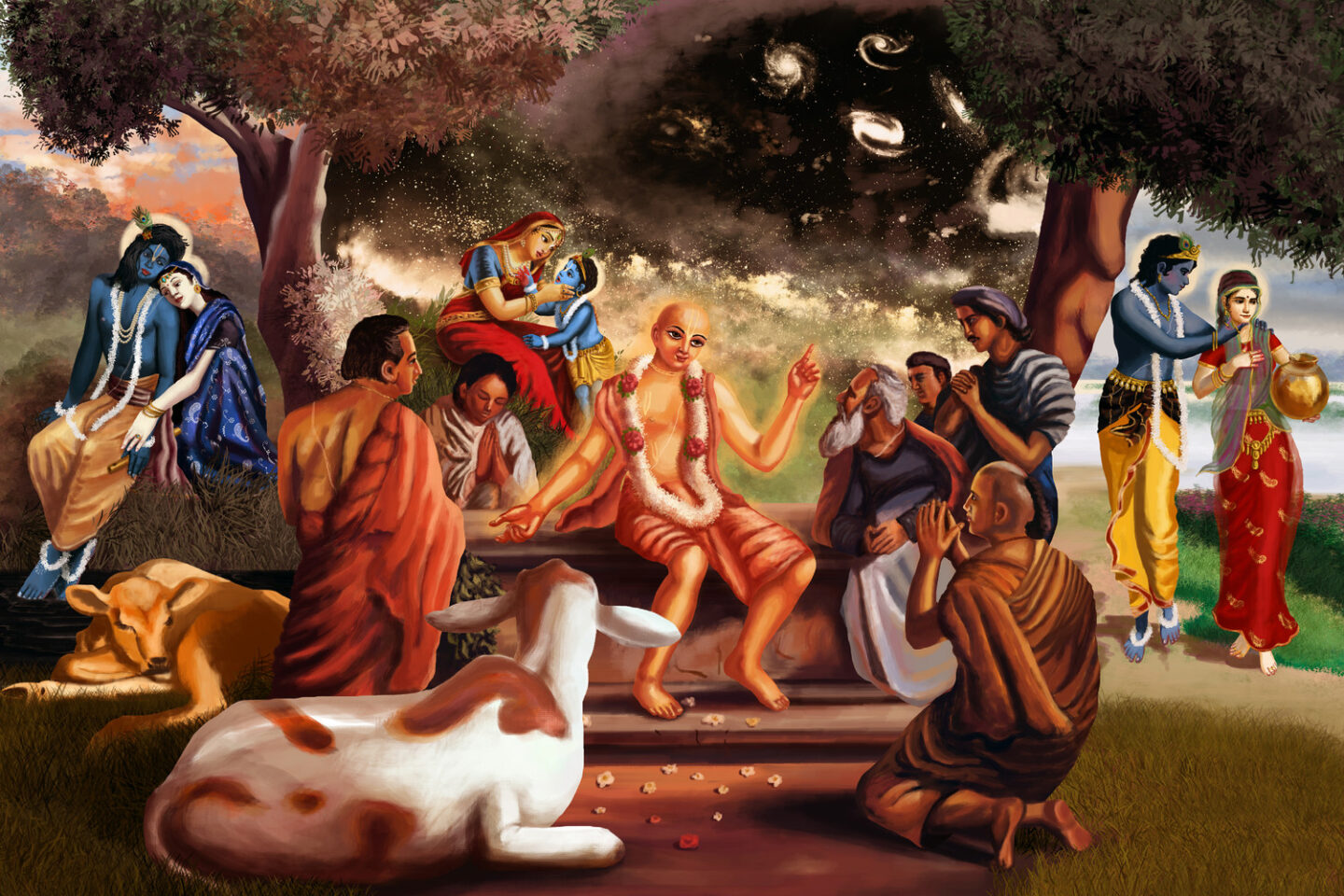
A famous verse composed by Rupa Goswami glorifies Him:
Namo mahā-vadānyāya kṛṣṇa-prema-pradāyate
Kṛṣṇāya kṛṣṇa-caitanya-nāmne gaura-tviṣe namaḥ
Chaitanya Mahaprabhu is described as the most munificent incarnation because He freely distributed Krishna-prema (love of God). He is Krishna Himself, appearing in the form of a devotee, to teach the chanting of the holy name.
The Central Teaching: The Supremacy of the Holy Name
Mahaprabhu emphasized that among all processes of devotional service—hearing (śravaṇam), chanting (kīrtanam), remembering (smaraṇam), worship (arcanam), offering prayers (vandanam), serving (dāsyam), friendship (sakhyam), and full surrender (ātma-nivedanam)—the most important is nāma-saṅkīrtana, the chanting of the holy name.
Without the holy name, nothing has real value. All other processes—karma-yoga, jñāna-yoga, tapasya, charity, austerity—are insignificant compared to the chanting of the name of God. The holy name stands above everything.
Although many saints such as Tukaram, Tulsidas, and Ramanujacharya emphasized the importance of God’s name, Chaitanya Mahaprabhu did something unique. Through His followers, He established a vast body of scholarly literature in Sanskrit exclusively focused on bhakti and the science of the holy name.
Why Sanskrit? A Strategic Vision
Mahaprabhu instructed His followers, especially the Six Goswamis of Vrindavan, to write in Sanskrit. Although they were fluent in Bengali, Hindi, and even Persian, they deliberately chose Sanskrit—the scholarly language of authority.
Because Mahaprabhu was thinking of the future. If the teachings were only written in local languages, scholars might dismiss the movement as sentimental. By establishing the philosophy with scriptural evidence in Sanskrit, He ensured that intellectuals, philosophers, and highly learned people would take it seriously.
His target was not merely the masses. For the masses, there was kirtan—chanting, dancing, and joyful participation. But for the intellectual class, there had to be deep philosophy.
As Srila Prabhupada often summarized:
“Kirtan for the masses, philosophy for the classes.”
Mahaprabhu debated great scholars and Mayavadis. He transformed Sarvabhauma Bhattacharya, the greatest scholar in Jagannath Puri, and influenced King Prataparudra. When leaders and intellectuals change, society follows.
A Multi-Level Mission
Mahaprabhu’s strategy was systematic:
- He personally performed public kirtan to attract ordinary people.
- He sent Nityananda Prabhu to preach to wealthy merchants and even dacoits.
- He instructed Rupa and Sanatana Goswami to write philosophical works to defeat impersonalism and establish pure bhakti.
He spread a net of divine love across all levels of society—common people, scholars, leaders, wealthy individuals, and even animals. His compassion was not random; it was strategic.
From Mission to Movement
Following this same mood, Bhaktisiddhanta Sarasvati Thakur established the Gaudiya Mission. He deliberately used the word “mission,” indicating an organized effort to transform society, not merely a temple institution.
Later, Srila Prabhupada expanded it globally as the International Society for Krishna Consciousness—a movement. When a mission spreads worldwide and becomes a spiritual revolution, it becomes a movement.
This was not accidental. It was deliberate, intelligent planning rooted in compassion.
Compassion Requires Intelligence
Real mercy is not sentimental. It requires intelligence and strategy.
It is not enough to simply distribute prasadam or open temples without thought. One must consider:
- How will people be attracted?
- How will they stay?
- How will they be elevated spiritually?
Large marble temples may attract certain people. A simple rural ashram may attract others. A Vedic college may attract intellectuals who would never step into a temple. Different approaches are required for different audiences.
However, strategy must remain pure. There must be no manipulation, no exploitation, no lower modes of attraction. Introducing rajasic or tamasic elements to draw crowds—such as sensationalism or distortion of principles—ultimately disconnects people from Krishna rather than connecting them.
Srila Prabhupada clearly said:
“I will give you the plan; you fill in the details.”
The details may vary according to time, place, and circumstance, but the principles must never be compromised.
Preaching as Spiritual Responsibility
Prabhupada even described preaching as our “business.” Just as a businessman thoughtfully presents a product and explains its benefits, devotees must thoughtfully present Krishna consciousness.
Our “product” is Krishna-prema.
Our “brochure” is Bhagavad-gita and the books of the acharyas.
Our goal is transformation—not profit, not prestige, but spiritual upliftment.
Mahaprabhu promised that one who sincerely tries to spread the holy name will not be overcome by maya and will ultimately return to Him.
But there is one condition: no duplicity, no selfish motives, no hidden agendas. Strategy must be guided by sincerity and fidelity to the parampara.
Namo Mahā-Vadānyāya: Not Magic, but Mission
When we say “Namo Mahā-Vadānyāya”—we are not speaking of cheap miracles. Mahaprabhu’s mercy is vast, but it works through sincere effort, thoughtful engagement, and dedicated service.
We must work on ourselves, think about others and must apply intelligence in spreading bhakti.
Then His mercy flows.
Simply shouting “Kripa karo!” (Please give mercy!) without responsibility will not bring transformation. Compassion, like Mahaprabhu demonstrated, requires planning, intelligence, courage, and purity.
That is the real meaning of His munificence—and that is the spirit of this movement.