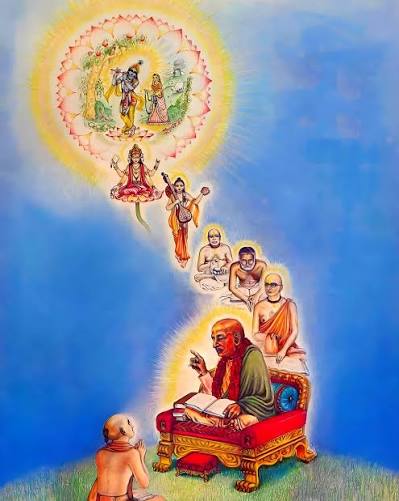
Guru Pūrṇimā is traditionally celebrated across India as a day to worship and honor the spiritual master. In different traditions—Madhva, Rāmānuja, and others—this day holds special significance for honoring the guru.
In ISKCON, there is a slightly different practice. The actual appearance day of one’s spiritual master is celebrated as Vyāsa-pūjā. But traditionally, Guru Pūrṇimā is not specifically about worshiping one’s guru according to his or her birth date. It is a day to honor the entire guru-paramparā—the whole disciplic succession.
And there is an important connection with Śrīla Vyāsadeva, the guru of gurus. On this day, we can remember and honor Vyāsadeva and also worship our own spiritual master as his representative and as part of the disciplic succession.
But perhaps the greatest significance of Guru Pūrṇimā is not simply performing a ritual.
It is a day of contemplation.
We worship the guru and guru-paramparā every day. We offer flowers, prayers, and respect. But sometimes, because it becomes a daily ritual, we may perform it without deeply contemplating what these great ācāryas actually contributed to the world.
Guru Pūrṇimā gives us an opportunity to pause and consciously remember their contributions.
Every ācārya made a particular contribution at a particular time. We should ask:
Why did this ācārya make that contribution?
What was the historical context?
What was happening in society at that time?
Why was that particular teaching or movement necessary?
When we understand not only what the ācāryas did, but why they did it, we begin to understand their consciousness.
And by understanding their consciousness, we learn how to practice Kṛṣṇa consciousness ourselves—and how to share Kṛṣṇa consciousness with the world for the benefit of everyone.
So, on this Guru Pūrṇimā, we can certainly worship the guru and the paramparā. We can also remember Vyāsadeva, read Śrīmad-Bhāgavatam and Mahābhārata, and contemplate his extraordinary contributions.
But beyond the ritual, let this be a day of manana—a day of deep remembrance and contemplation.
Let us remember the gurus, their contributions, their historical context, their consciousness, and most importantly, why they came and what they wanted to give to the world.
That may be one of the most meaningful offerings we can make on Guru Pūrṇimā.