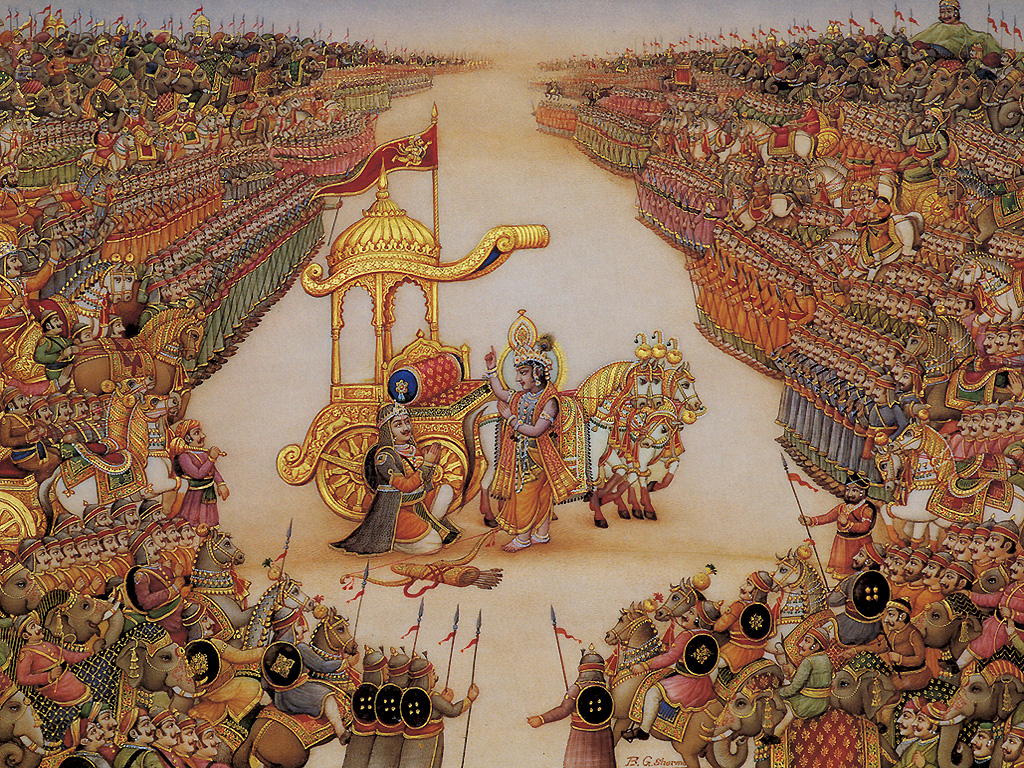
— Why It Remains the Heart of Sanātana-Dharma
The Bhagavad-gītā is universally regarded as one of the crown jewels of sanātana-dharma. Within the vast landscape of Vedic literature—Vedas, Upaniṣads, Purāṇas, Pañcarātra, dharma-śāstras, and smṛti-śāstras—the Gītā occupies a uniquely elevated position. Other texts cover a wide spectrum of subjects, from Ayurveda and music to rituals, cosmology, karma, and liberation. Yet the ultimate purpose of human life—attaining loving devotion (prema) to Bhagavān—remains scattered and subtle within these scriptures.
Out of His compassion for the bewildered human race, Śrī Kṛṣṇa clarified this essential truth five thousand years ago through the Bhagavad-gītā. It condenses the wisdom of all Vedic literature into a single, practical dialogue. Everything found in other śāstras is contained within the Gītā, yet many of the Gītā’s teachings are not available anywhere else. No wonder Śaṅkarācārya proclaimed, “ekaṁ śāstraṁ devakī-putra-gītam”—let the Gītā alone be the supreme scripture. Lord Śiva even declared that a scholar who has not studied it becomes laughable.
Kṛṣṇa summarizes the essence of all Vedic knowledge in one simple declaration:
vedaiś ca sarvair aham eva vedyaḥ (BG 15.15) — All the Vedas aim only to reveal Me.Thus, after studying the Vedas, one must ultimately take shelter of Śrī Kṛṣṇa.
Kṛṣṇa’s Loving Appeal Throughout the Gītā
A striking feature of the Bhagavad-gītā is its consistency: from the first chapter to the last, it gently but firmly guides the reader toward exclusive surrender to Kṛṣṇa.
- In Chapter 5, Kṛṣṇa reveals that peace comes to one who recognizes Him as the enjoyer, the Lord of the universe, and the well-wishing friend of all beings.
- In Chapter 8, He explains that even the greatest Vedic results—gained through study, yajña, or charity—are surpassed by simple devotion.
- In Chapter 12, He declares that those who relish the nectar of bhakti become extremely dear to Him.
- And near the end, He gives the Gītā’s most celebrated instruction:
“sarva-dharmān parityajya mām ekaṁ śaraṇaṁ vraja” (18.66).
The final verse (BG 18.78) concludes with the assurance that wherever Kṛṣṇa and His devotee stand together, prosperity, victory, righteousness, and power naturally manifest.
Seen as a whole, the Gītā is not merely a philosophical treatise—it is a heartfelt invitation. Just as parents yearn for their children to return home, Kṛṣṇa longs for us to come back to Him. Even though descending to this world is far beneath His divine stature, He does so purely to remind us of our forgotten path.
Living the Gītā Instead of Merely Reading It
The Bhagavad-gītā is not meant to be read once and set aside. It must be studied again and again, for each reading reveals fresh insights. Personalities as diverse as Mahatma Gandhi and Western philosophers like Schopenhauer drew life-long inspiration from it.Yet true transformation comes only when we live the Gītā.
Understanding the basic truth—“I am not this body, but the eternal ātmā” (BG 2.13)—takes sustained introspection. Cultivating divine qualities like humility, tolerance, simplicity, and nonviolence (described in Chapter 13) requires genuine effort. As we apply the Gītā’s teachings, we slowly become “walking Gītās”—individuals whose character conveys its wisdom even without words.
Naturally, living the Gītā inspires us to share it. Practice (ācār) and sharing (pracār) reinforce each other and bring depth to spiritual life.
Śravaṇam and Kīrtanam: The Heart of Understanding
Kṛṣṇa advises Arjuna that if deep understanding feels difficult, one should simply engage in śravaṇam (hearing) and kīrtanam (speaking). When one studies alone, there is a risk of accepting ideas that feel pleasant and ignoring those that challenge us. Therefore, hearing from realized devotees is essential.
A single moment of hearing from a sādhu can illuminate truths that hours of reading may not.
Similarly, kīrtanam—speaking, teaching, discussing, and distributing the Gītā—helps fix its teachings firmly in the heart. Kṛṣṇa promises:
dadāmi buddhi-yogaṁ taṁ yena mām upayānti te (10.10)
To those who worship Him with devotion, He personally gives the intelligence to reach Him.
External guidance comes from sādhus; internal guidance comes from Bhagavān Himself. Hence, sādhu-saṅga becomes the indispensable foundation of spiritual growth.
The Joyful Process Taught by the Gītā
Kṛṣṇa describes the path of bhakti as the king of knowledge, the most confidential wisdom, and “su-sukhaṁ kartum”— joyful to practice (BG 9.2). The process naturally includes music, kīrtana, drama, and prasādam. What more could one desire?
By contrast, the paths of austerity, pure contemplation, or impersonal renunciation are arduous and often barren. The Gītā simplifies both sādhana (practice) and sādhya (the goal). Sādhus study deeply and reveal the nectar; sincere listeners simply hear and absorb.
Thus the Gītā gently leads one not only to liberation but ultimately to Kṛṣṇa-prema, the highest perfection of life.
Scripture With Reason: The Gītā’s Clarity and Logic
Bhagavān never demands blind belief. The Gītā offers both jñāna (knowledge) and vijñāna (realized understanding). It explains the reasoning behind moral discipline, devotional practice, and even simple acts like offering flowers or bowing before the deity.
For this reason, the Gītā is known as:
- nirṇaya-śāstra — the scripture that resolves doubts
- brahma-nāśinī — destroyer of illusion
Few scriptures present logic and devotion in such perfect balance.
Why We Are Here—and What We Must Do
A common misconception is that God has sent us into this world. Just as no loving parent sends a child to prison, Bhagavān never sends anyone to the material world. We came here ourselves, driven by our own desires, attachments, and errors.
The body is a temporary prison, yet we cling to it. We must care for it but remember that it is not our true identity.Our real beloved is Krsna alone.
In this way, the Gītā speaks directly to the human condition—our struggles, fears, confusions, and hopes—and elevates them toward a divine purpose.
Read the Bhagavad-gītā Now, Not After Death
Traditionally, paṇḍits recite the Gītā after someone passes away. Yet the departed soul would have benefited far more by studying it while alive. The Gītā is a guidebook for the journey of life—not a closing ritual at its end.
Those who read the Gītā feel inspired to distribute it. Keeping extra copies and sharing them is a wonderful service. Often, the person who receives a Gītā may understand it better than we do and distribute it further, creating a chain of mercy in which everyone benefits.
This month—when Bhagavān originally spoke the Gītā—is especially auspicious for reading and distributing it.