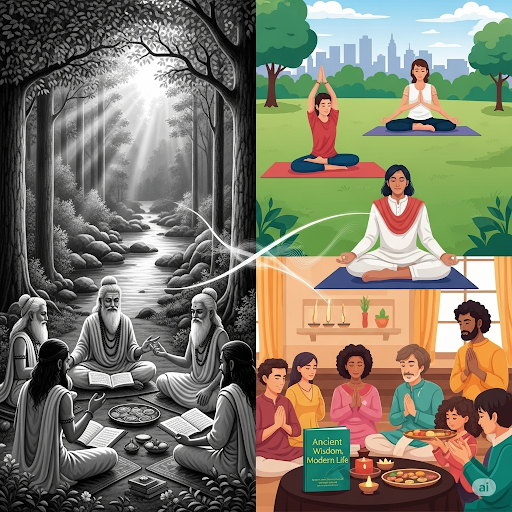
The Vedic Culture, known as Sanātana Saṁskṛti, is the foundation of true civilization. Saṁskṛti means culture, and it is called Sanātana—eternal—because it is not bound by time, place, or circumstance. Just as one plus one is always two, the principles of Sanātana Saṁskṛti remain timeless.
While technology and lifestyles may change, the eternal values of truth, compassion, discipline, and respect remain unshaken. Thousands of years ago, the Vedas instructed us to speak the truth and show mercy; today, these values still hold the same relevance. This unbroken flow of wisdom is what makes Vedic Saṁskṛti truly eternal.
Meaning of Saṁskṛti
The word Saṁskṛti is formed from saṁ (completely) and kṛti (the result of action). It means to act in a perfect manner. A person rooted in Saṁskṛti develops two essential qualities:
- Ācār – personal conduct, including purity in thought, dress, and discipline.
- Vyavahār – social interaction, reflected in speech, behavior, and respect for others.
Without these, society slips into chaos and animalistic tendencies. It is Saṁskṛti that transforms human life into a civilized, cultured, and harmonious existence.
Source of True Culture
Modern education teaches science and technology but neglects values. Children may learn how to operate machines, but rarely are they taught how to respect parents, elders, or even the food they eat. The Vedic Śāstras remind us that food is divine, a representation of Lord, since life itself is sustained by it. Hence, Vedic culture trains us not just in knowledge, but in right living.
The Vedas – Fountainhead of Knowledge
The word Veda comes from the root vid, meaning “to know.” Thus, the Vedas are that through which one can know the truth. They are four in number—Ṛg, Sāma, Yajur, and Atharva—each containing Saṁhitā, Brāhmaṇa, Āraṇyaka, and Upaniṣad.
The Vedas encompass every branch of knowledge—language (śikṣā, vyākaraṇa, nirukta), rituals (kalpa), astronomy (jyotiṣa), prosody (chandas), Ayurveda (health), Dhanurveda (martial arts), Sthāpatyaveda (architecture), Gandharvaveda (music, dance, and drama), along with Purāṇas, Itihāsas, and Vedānta. Modern sciences are but fragments of this ocean of wisdom.
The Role of Vedic Education
A Vedic college does not merely impart information; it nurtures nīti (morality), dharma (righteousness), and bhakti (devotion). Its purpose is to raise individuals who can govern society wisely, live healthily, preserve tradition, and ultimately dedicate their lives to Lord.
Through subjects like Khaṇḍanam (refutation of misconceptions) and Maṇḍanam (establishing the truth), students are equipped not only with knowledge but also with the ability to protect dharma and counter false ideologies. Training in Sanskrit further allows seekers to access the wisdom of the śāstras in their original, divine form.
Relevance for Today
In today’s world, children are losing touch with values. Respect for parents, discipline in life, and reverence for God are fading. Vedic Saṁskṛti emphasizes beginning each day with obeisance to Lord and parents, cultivating humility and gratitude from the very start of life.
Even arts such as dance, music, and drama are not mere entertainment in Vedic tradition—they are forms of learning, expression, and even self-defense when studied through Gandharvaveda. Similarly, Sthāpatyaveda ensures that living spaces harmonize with cosmic principles, enhancing prosperity and peace.
The Eternal Relevance
Vedic Saṁskṛti is not about blind tradition—it is a holistic way of life that perfects human conduct, enriches society, and aligns man with divinity. It teaches us what to eat, how to live, how to speak, and how to think. It refines the individual, uplifts the family, strengthens the nation, and benefits the entire world.
The ultimate goal of Vedic Saṁskṛti is not just survival or material success—it is to live for the sake of Lord, in harmony with dharma, and in service to humanity. By reviving and protecting this culture, we not only preserve our past but also safeguard our future.